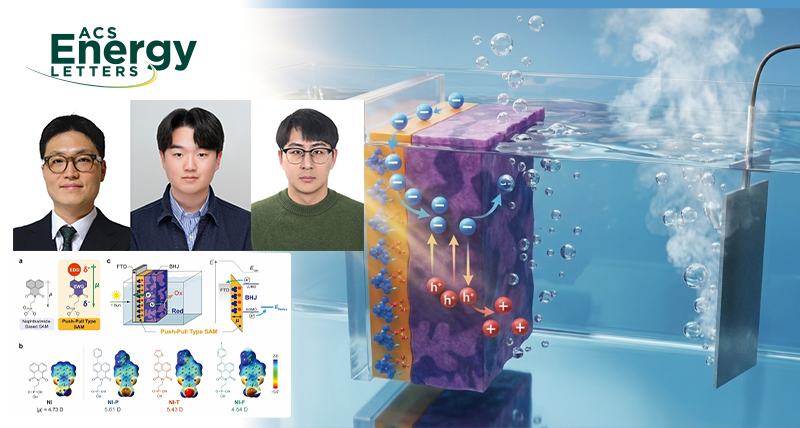
A research team, led by Professor Han-Hee Cho from the Department of Materials Science and Engineering at UNIST has unveiled a new naphthalimide-based self-assembled monolayer (SAM) film that can dramatically enhance the efficiency of solar water splitting. Thanks to this breakthrough, the race to commercialize solar-powered hydrogen(H2) production from water is gaining momentum.
The solar-powered H2 production involves shining sunlight on a photoelectrode submerged in water to split it into H2 and oxygen. When the semiconductor inside the photoanode absorbs sunlight, it releases electrons that travel through the material to drive the chemical reaction, producing H2.
The team’s newly developed SAM acts as an electron transfer layer between the organic semiconductor and the substrate. Traditionally, this role has been filled by metal oxide layers, which tend to be thick and less efficient at transferring charge.
In tests, applying this molecular layer to the photoelectrode yielded a current density of 7.97 mA/cm²—outperforming other organic-based photoelectrodes based on bulk heterojunction (BHJ) materials. Higher current densities translate into faster, more efficient H2 production.
One of the key advantages of this approach is that these organic molecular films self-assemble, eliminating the need for costly, energy-intensive manufacturing processes associated with metal oxide layers.
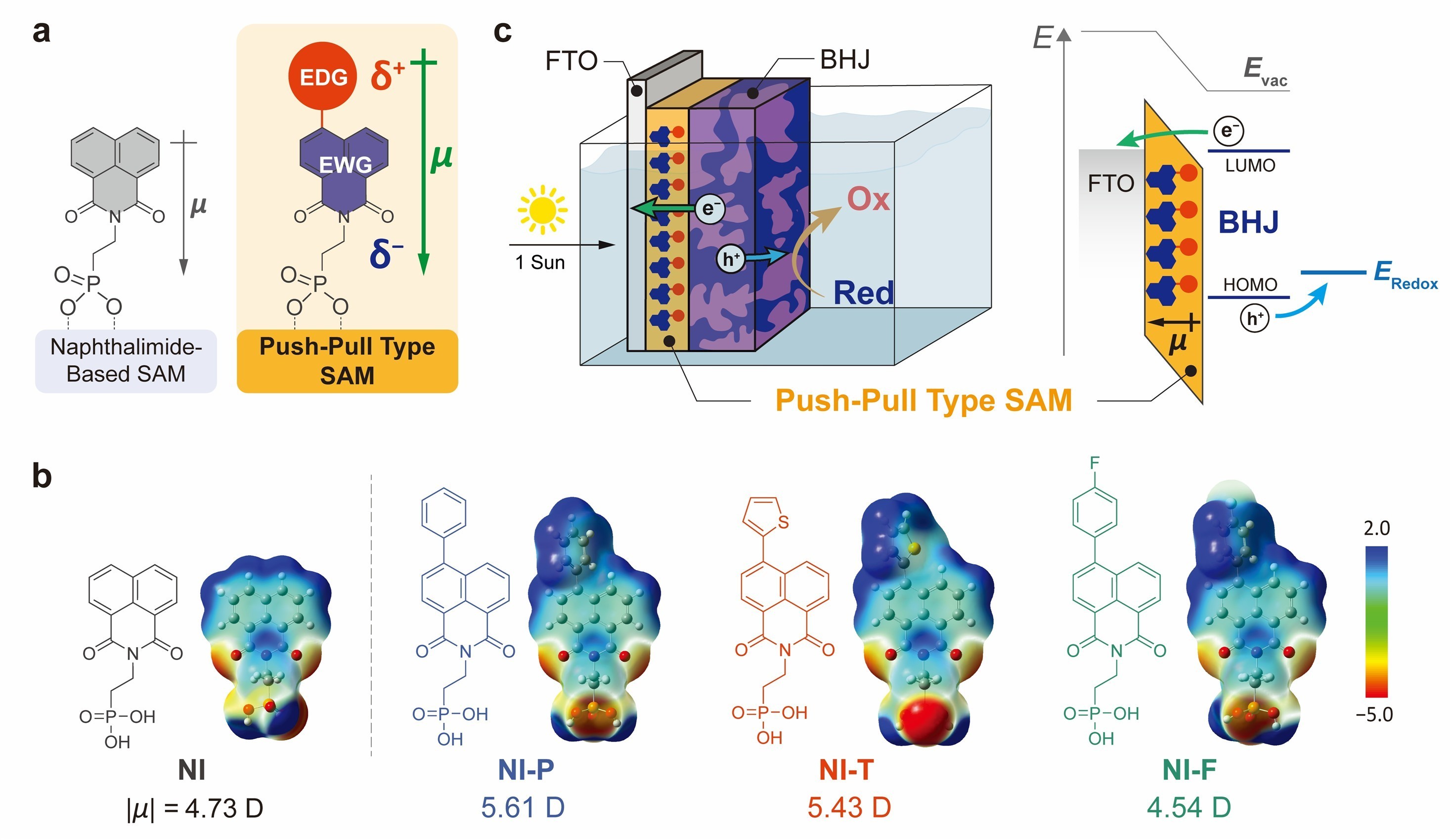 Figure 1. Schematic illustration of the molecular architecture and overall design of the study, highlighting the push-pull structure and the components of the photoelectrode.
The team designed these molecules with a push-pull architecture—meaning they contain both electron-donating and electron-withdrawing groups within the same molecule. This structure creates a strong internal electric field, reducing energy barriers and enabling electrons to tunnel through the layer more easily. This quantum tunneling effect allows for more efficient charge transfer across the interface.
Professor Cho explained, “Organic semiconductor-based photoelectrodes are attractive because they are affordable and can be produced over large areas. This self-assembled molecular film takes us a step closer to making solar-powered H2 production commercially viable.”
He further added, “The push-pull molecular design strategy we used is not just limited to H2 generation. It has the potential to improve a wide range of optoelectronic devices, like solar cells, LEDs, and optical sensors, where efficient electron extraction is essential.”
The findings of this research was published online in ACS Energy Letters on November 11, 2025. The project received support from the Korean National Research Foundation (NRF) through various funding programs, including basic research, early-career research, the InnoCORE program of the Ministry of Science and ICT (MSIT), and the Swiss ETH Leading House Asia.
Journal Reference
Euimin Lee, Donghyun Lee, Gyujin Jang, et al., “A Push–Pull Type Electron-Selective Self-Assembled Monolayer in Organic Semiconductor Photoanodes for Solar Water Oxidation,” ACS Energy Letters, (2025).