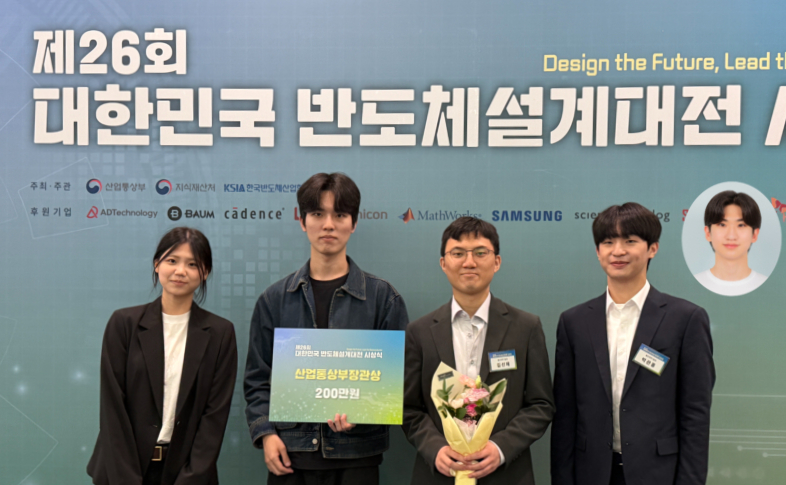
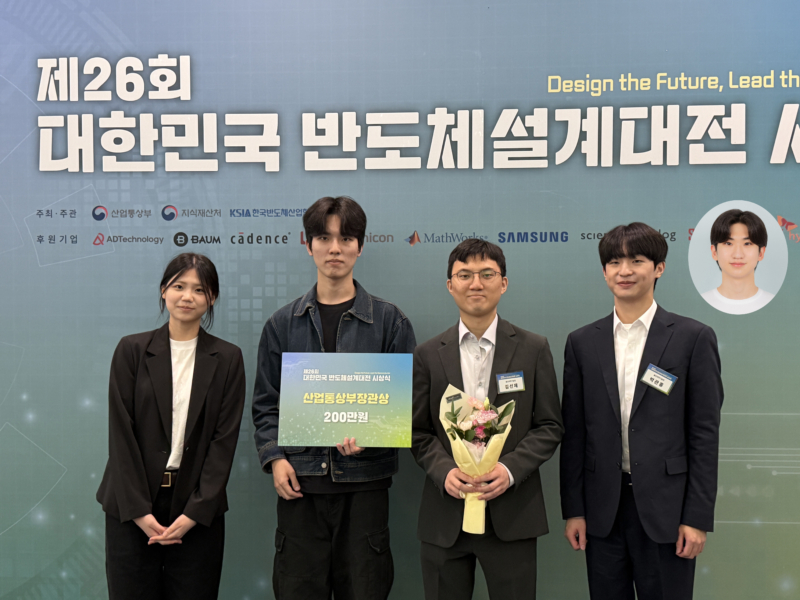
A research team, led by Professor Jongeun Lee from the Department of Electrical Engineering at UNIST has been honored with the Minister’s Commendation from the Ministry of Trade, Industry and Energy (MOTIE) at the 26th Korea Semiconductor Design Competition, the nation’s most prestigious event in semiconductor design.
The team, consisting of Jeawoo Lim, Myeong Hyeon Cho, SunJae Kim, Gwan Hong Park, and Geonho Kim, secured first place among all undergraduate teams at the 26th edition of the competition. Notably, they are the only undergraduate team to receive a government award this year.
Organized jointly by MOTIE and the Korea Semiconductor Industry Association, the competition aims to enhance semiconductor design capabilities and foster innovative ideas among university and research institute teams nationwide. This year’s contest saw unprecedented levels of competition.
Team UNIST ICCL garnered attention with their project titled “Accelerator IP Design for GNN-Based Potential Field Models for Molecular Dynamics Simulation.” Molecular dynamics simulation is a technique that models atomic-level movements, playing a crucial role in fields requiring high precision such as semiconductor device design and drug development.
To accelerate this process, machine learning-based potential field models (MLFF) have been developed, offering improvements in both accuracy and speed. However, calculations still require extremely fine time steps—on the order of 1 femtosecond—which makes further acceleration essential.
The team selected the ‘Orb Model‘ among various MLFF approaches and focused on optimizing the performance bottleneck: the ‘AttentionInteractionNetwork Module,’ which handles data interactions—a critical component for overall efficiency.
Additionally, to enhance data processing efficiency, the team applied a systolic array architecture for rapid matrix operations, along with loop tiling techniques and HBM bandwidth optimization to improve high-bandwidth memory data transfer.
This innovative accelerator was first implemented on AMD Xilinx U50 FPGA , a reconfigurable programmable chip. The result was a performance surpassing that of existing CPU and GPU-based commercial systems, achieved entirely by the undergraduate team—a rare accomplishment that highlights their exceptional talent and dedication.
SunJae Kim, the team leader, expressed his pride, “Receiving the Minister’s Award at such a prestigious competition is a true honor. Through numerous trials and errors, I learned the depth of research and felt the rewarding power of teamwork.”
This achievement was made possible through an undergraduate-only fusion research project (UIRP), where students defined problems and designed solutions independently, producing results with real-world industry applicability beyond laboratory experiments.
Professor Lee commented, “I am deeply impressed by how students thought independently and carried out the entire design process themselves. This UIRP experience has fostered integrated education and hands-on research, and I hope it will provide more students with opportunities to gain practical project experience in the future.”



![[2026 UNIST Matriculation] “Design Questions the World Has Never Seen!”](https://news.unist.ac.kr/wp-content/uploads/2026/02/사진-박종래-UNIST-총장이-2026년-입학식사를-전하고-있다-1-1-190x122.jpg)