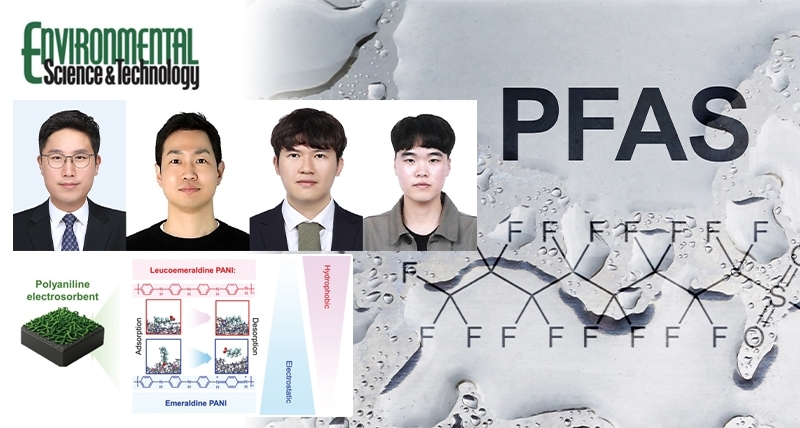
A research team, affiliated with UNIST has unveiled a novel method to tackle PFAS (Per- and polyfluoroalkyl substances), also known as the Forever Chemicals due to their resistance to natural degradation over hundreds of years.
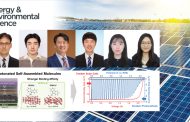
Professors Kwiyong Kim (Department of Civil, Urban, Earth, and Environmental Engineering) and Byungjo Kim (Graduate School of Semiconductor Materials and Devices Engineering) at UNIST have created an electrochemical process using conductive polymers to adsorb, concentrate, and decompose low-concentration PFAS in water. This approach leverages the changing electrical states of the polymer to enable reversible adsorption and desorption, allowing selective removal with significantly reduced energy consumption.
When applied to wastewater, the system achieved over 90% removal of PFOA from solutions with just 100 parts per billion—operating at less than one-twentieth the energy of conventional methods. The team also developed an integrated system combining adsorption and electrochemical decomposition in a continuous process, simplifying treatment and making it more efficient.
Unlike traditional techniques that involve separating PFAS for incineration or landfilling—which merely isolate the chemicals—this technology allows for their complete breakdown, reducing environmental persistence.
Professor Kim explained, “Our conductive polymer-based system does not require chemical regeneration, making it a cost-effective and eco-friendly alternative for low-concentration wastewater. It can easily release captured pollutants without additional chemicals and streamline the entire treatment process.”
Molecular dynamics simulations further clarified how the polymers adsorb and release PFAS, providing insights for designing more effective materials.
Published in Environmental Science & Technology on January 13, this research was supported by the Ministry of Science and ICT, the National Research Foundation of Korea, and the Korea Institute for Industrial Technology.
Journal Reference
Sunghoon Doh, Sangmin Eom, Suk Soon Choi, et al., “Polyaniline as an Integrated Amine-Redox Platform for Reversible Electrosorption and Energy-Efficient PFAS Remediation: From Molecular Mechanisms to System Integration,” Environ. Sci. Technol., (2025).