At the center of industrial transformation in Korea’s southeastern region, UNIST will lead the Manufacturing AX—as the R&D control tower, reshaping the future of national industry.
UNIST President Chong Rae Park has unveiled a comprehensive regional R&D innovation strategy aimed at accelerating industrial AI-driven manufacturing innovation across the southeastern region of Korea, positioning UNIST as the central R&D control tower for Manufacturing AI Transformation (M.AX) and a key architect of the nation’s next industrial leap.
Speaking at a press briefing held on January 10, President Park outlined UNIST’s vision to strengthen the global competitiveness of flagship industries, while advancing next-generation technologies through region-led innovation.
Under the banner of becoming a ‘S&T Innovation Hub, Driving Industrial Renewal and Future Growth,’ UNIST presented a four-pillar strategy, spanning research, talent cultivation, infrastructure, and entrepreneurship. The strategy focused on securing breakthrough technologies through AI-driven transformation, cultivating advanced S&T talents and encouraging regional retention of skilled professionals, establishing open research platforms to strengthen corporate competitiveness, and building a robust deep-tech startup ecosystem to translate research into market-driven innovation.
The strategy focuses on securing breakthrough technologies through AI-driven transformation, cultivating advanced scientific and engineering talent and encouraging regional retention, establishing open research platforms to strengthen corporate competitiveness, and building a robust deep-tech startup ecosystem to translate research into market-driven innovation.
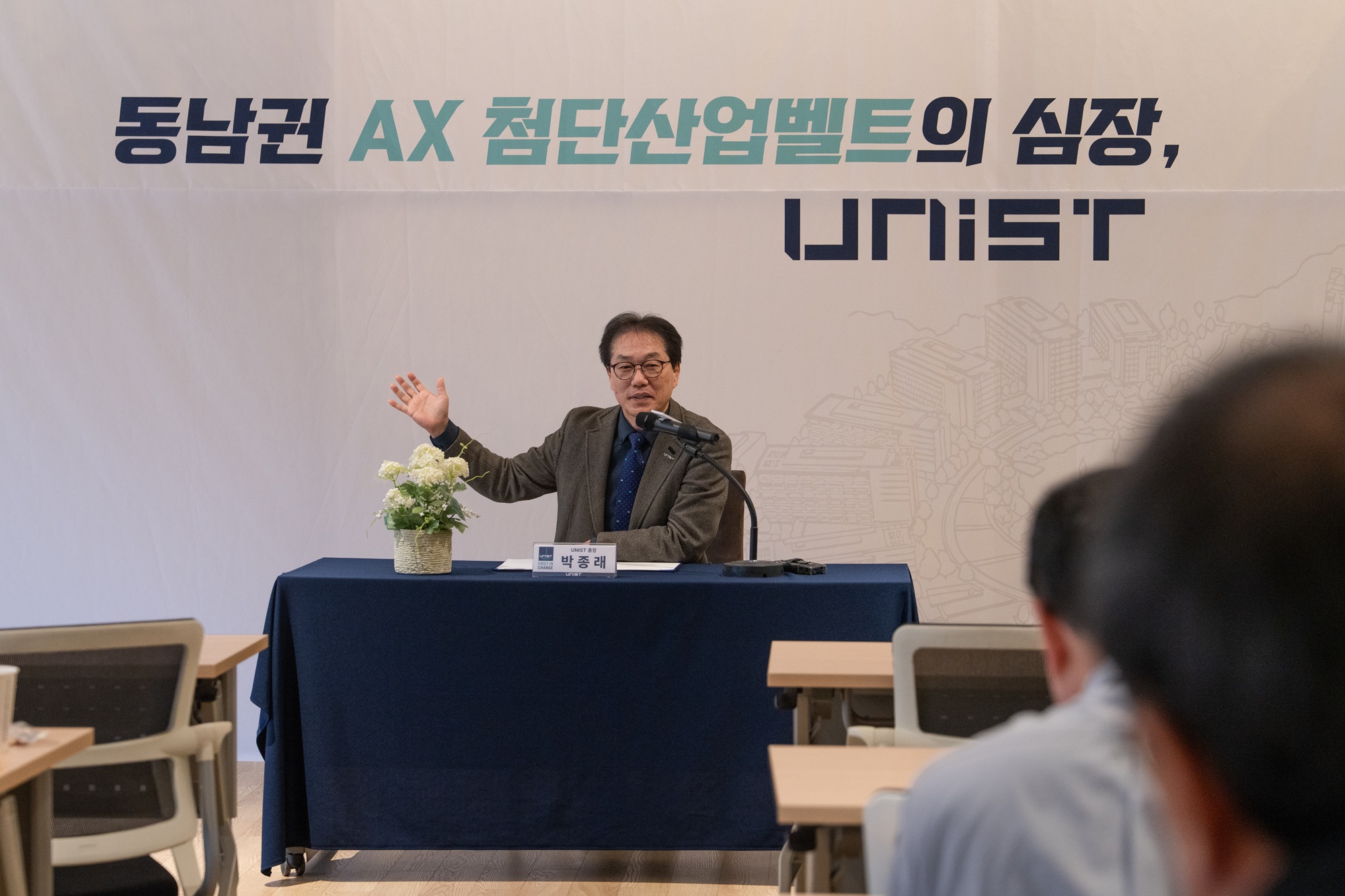
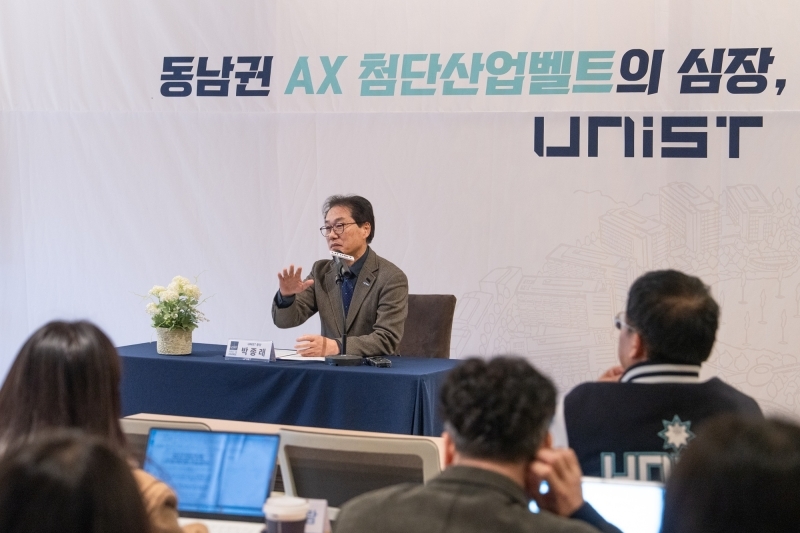
President Chong Rae Park highlights UNIST’s role in strengthening the competitive edge of key industries in the southeastern region of Korea.
This initiative aligns with the Korean government’s regional R&D innovation support project, known as the ‘4-Pole, 3-Special Zone,’ which seeks to decentralize research governance and empower regions to design and implement R&D agendas tailored to local industrial needs.
The initiative represents a shift from centrally driven, competitive funding models to a decentralized framework in which regions independently plan and execute their own priority R&D programs in close collaboration with universities and industry partners. Under this system, four major institutes of science and technology will serve as regional hubs across four core regions—Central, Honam (Southwest), Daegu-Gyeongbuk, and Dongnam (Southeastern)—alongside three designated special self-governing provinces—Gangwon, Jeonbuk, and Jeju. Government funding is expected to reach approximately KRW 13.1 billion per regional hub in 2025, increasing at least KRW 26 billion annually from 2026 onward.
At the center of UNIST’s strategy is ‘AI Transformation (AX) for Manufacturing Industries,’ integrating AI and data technologies across key sectors in Korea’s southeastern region, including shipbuilding, marine engineering, machinery, aerospace, steel, and petrochemicals. By connecting full-cycle industrial data—from design and production to operations and application—the initiative aims to establish an intelligent industrial ecosystem that transforms traditional manufacturing clusters into advanced future-industry hubs, enhancing productivity, quality, and global competitiveness.
To achieve this, UNIST will lead the regional R&D consortium, coordinating shared core technologies, technical standards, and solution development across universities, national research institutes, and industry partners. The approach is designed to create a virtuous cycle that directly connects research planning directly with field-level implementation and commercialization.
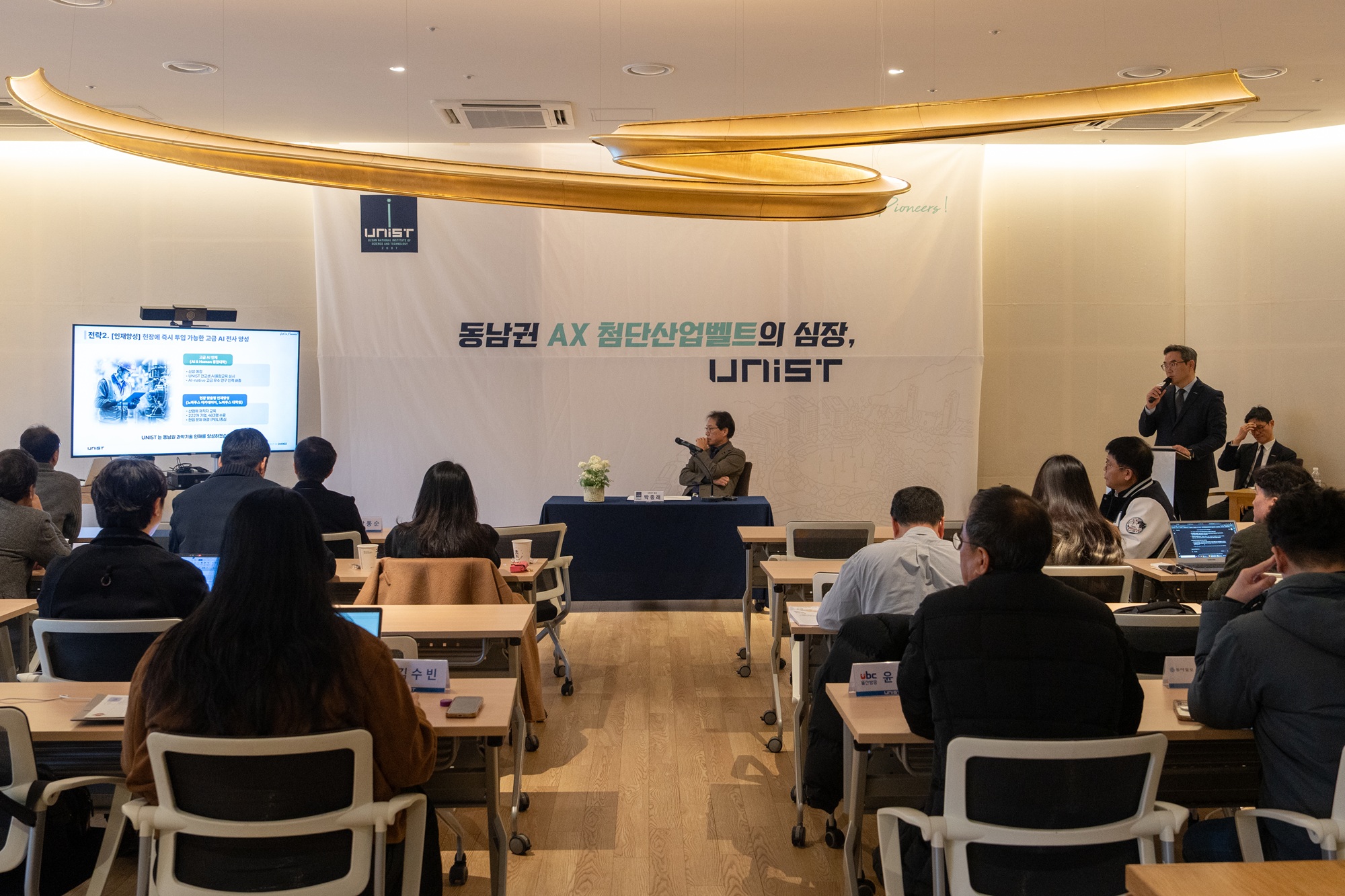
Dean Han Gi Chae (right) from the Office of Budget and Planning outlines UNIST’s vision as a Southeastern Regional Innovation Hub.
Leveraging its Graduate School of Artificial Intelligence—the only dedicated AI graduate program in the region—UNIST will establish a hub for developing industry-ready AI models and solutions. In parallel, the university will strengthen collaborative governance with national research institutes to support validation, technology diffusion, and global expansion. Joint projects with major corporations are expected to further accelerate M.AX and commercialization outcomes.
Talent cultivation forms another key pillar of the strategy. UNIST plans to launch an ‘AI & Human Convergence College‘ in 2026, delivering AI-integrated education across all disciplines. A comprehensive talent pipeline will link undergraduate, graduate, and industry-tailored programs to cultivate professionals equipped for immediate real-world deployment. Through the Novatus Academia and Novatus Graduate School, UNIST will also expand continuing education and problem-based learning opportunities for working engineers and managers.
UNIST will further open and enhance its research infrastructure for industry partners, providing access to supercomputing resources, advanced equipment, and technical training facilities. This one-stop open platform will support the full innovation cycle—from analysis and verification to prototyping and commercialization. High-performance computing capabilities combined with industrial data will drive the development of specialized AI models in mobility, shipbuilding, and energy sectors.
In entrepreneurship, UNIST will expand support for deep-tech startups by integrating fragmented regional resources and strengthening pathways from research to investment and commercialization. The university aims to establish a systematic ecosystem linking startups, technology holding companies, investors, and industry partners, while encouraging collaboration with anchor firms and strategic growth opportunities, including mergers and acquisitions.
President Park emphasized that the strategy extends beyond institutional goals to regional transformation. “By combining AI and data with the core industries of Korea’s southeastern region, we will create a new engine for sustainable growth,” he said. “Our priority is to deliver technologies that can be applied immediately in the field and to establish region-led standards for research and innovation.”
He then added, “Large-scale, coordinated R&D systems are essential for the region to emerge as a global industrial hub. UNIST stands ready to serve as the central platform for that transformation.”