A pioneering artificial leaf, capable of producing hydrogen using only indoor lighting has been developed, mimicking the way plants convert sunlight into energy. This breakthrough offers a new approach to recycling the nearly 19% of global electrical energy consumed by lighting, turning it into a valuable clean fuel.
Led by Professor Ji-Hyun Jang in the School of Energy and Chemical Engineering at UNIST, the research has engineered an artificial leaf that generates hydrogen under LED illumination through the integration of a high-performance photoelectrode and a hydrogen-generation catalyst.
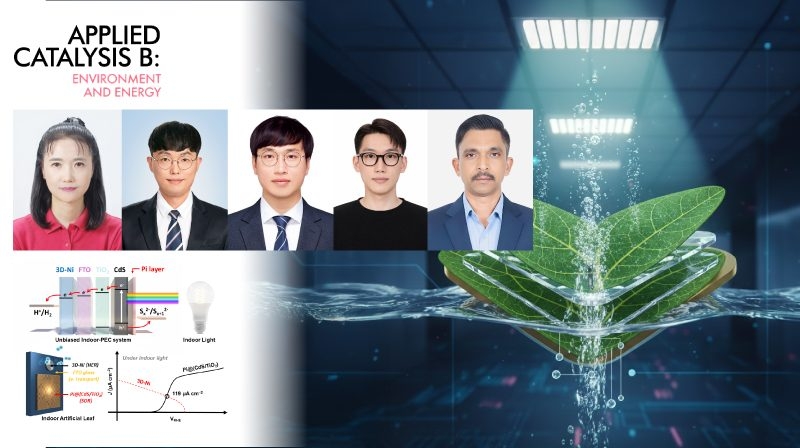
The heart of this system is the photoelectrode, which functions similarly to chlorophyll in plants by absorbing light to generate charge carriers. The team utilized a cadmium sulfide (CdS) sulfide-based material, which effectively captures the lower-intensity indoor lighting. The generated charges are transferred through a titanium dioxide (TiO₂) layer to a back-side catalyst composed of three-dimensional nickel (3D-Ni). On this surface, water reacts to produce hydrogen.
While sulfide materials are susceptible to photocorrosion under intense illumination, the researchers optimized the design for indoor lighting conditions to mitigate this issue. They further enhanced stability and efficiency by combining TiO₂ with the sulfide layer, preventing charge recombination. Coating the sulfide surface with phosphate (Pi) passivation also suppressed corrosion and improved charge transfer speed, resulting in a device that is both durable and highly efficient.

A schematic diagram summarising the overall research method from publication.
Remarkably, the artificial leaf achieved a photocurrent density of 119–120 microamperes per square centimeter (μA/cm²) under indoor lighting without any external voltage, maintaining 94% of its initial performance after 12 hours—performance comparable to devices using costly platinum catalysts. The photocurrent serves as a key indicator of the system’s hydrogen production capacity.
The team also assembled a large-area module, connecting four units of 85 cm² each, which collectively generated a total photocurrent of 5 milliamperes (mA) under indoor illumination, demonstrating its potential for practical applications.
Professor Jang stated, “Indoor lighting provides a stable and consistent energy source unlike solar power, which varies with weather conditions. Our work confirms that indoor light—often wasted—can be harnessed for hydrogen production. Moving forward, we aim to improve hydrogen separation and recovery techniques to further develop this technology for real-world use.”
The findings of this research have been published online in Applied Catalysis B: Environmental and Energy on March 16, 2026. The study has been supported by the ERC project of the Engineering Research Center for Microplastic through Bio/Chemical engineering Convergence Process, the Mid-Career Researcher Program, and the InnoCORE program of the Ministry of Science and ICT (MSIT).
Journal Reference
Jihun Kang, Ki-Yong Yoon, Seung Gyu Gyeong, et al., “Artificial-leaf hydrogen production: Advancing indoor renewable energy via phosphate-coated CdS/TiO2 heterojunctions,” Applied. Catal. B., (2026).