A research team, affiliated with UNIST has unveiled the development of a long-lasting, high-efficiency organic semiconductor photoelectrode capable of solar-driven hydrogen production at a world-class level. This breakthrough marks a significant advancement toward practical, sustainable hydrogen generation using organic materials.
Led by Professor Jin Young Kim of the UNIST Graduate School of Carbon Neutrality and Professor Han Young Woo of Korea University, the team engineered a novel material that enables uniform and strong attachment of platinum catalysts onto organic photoelectrodes. This innovation allows organic systems to achieve hydrogen production performance comparable to inorganic counterparts, while offering advantages in cost, flexibility, and weight.
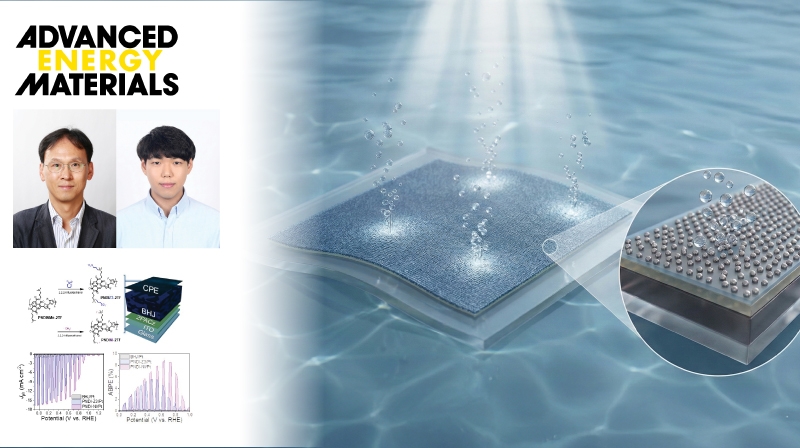
Solar hydrogen production involves illuminating a water-immersed photoelectrode, where sunlight excites the semiconductor’s active layer to generate electrons that drive water-splitting reactions, producing hydrogen gas. Platinum catalysts on the surface reduce the energy barrier for these reactions, making the process more efficient.
Despite their potential benefits, organic semiconductor-based photoelectrodes have faced challenges in achieving uniform catalyst coverage and long-term stability. Their inherently hydrophobic surfaces often hinder even catalyst distribution and lead to catalyst detachment over time, limiting their commercial viability despite their low cost and flexibility.
The research team developed a multifunctional polymer coating, called PNDI-NI, applied to the organic photoactive layer. Unlike conventional hydrophobic polymers, this polymer combines both hydrophobic and hydrophilic (water-attracting) properties, significantly improving surface wettability.
A key feature is the presence of iodide ions within the polymer, which promote rapid growth and strong adhesion of platinum nanoparticles by facilitating the reduction of platinum ions directly onto the surface. This results in densely packed, evenly distributed platinum particles that are firmly anchored, enhancing both catalytic activity and long-term stability.
Testing revealed that the coated organic photoelectrode achieved a photocurrent density of 17.69 mA/cm² under neutral conditions, with an applied bias photon-to-current efficiency (ABPE) of 8.88%. These figures represent the highest performance reported for organic-based photoelectrodes to date, approaching the efficiency of inorganic systems.
This research, with first authorship by Jung Min Ha from UNIST, Shuran Xu from Korea University, and Jaehyeong Kim from UNIST, offers a scalable, solution-based platform suitable for large-area fabrication. The entire process—from polymer coating to catalyst formation—can be performed in liquid, facilitating industrial application. Moreover, the approach can be adapted to incorporate various catalytic materials beyond platinum, broadening its potential for diverse applications.
Professor Kim states, “Our multifunctional polymer coating provides a simple yet effective solution for achieving uniform catalyst deposition and durable operation in organic photoelectrodes. This development offers a promising pathway toward practical solar hydrogen production.”
The findings of this research have been published in Advanced Energy Materials on January 6, 2026. This study has been supported by the National Research Foundation of Korea (NRF) and the Ministry of Science and ICT (MSIT).
Journal Reference
Jung Min Ha, Jaehyeong Kim, Shuran Xu, et al., “Conjugated Polyelectrolytes with Tunable Ionic Side Chains for Iodide-Mediated Pt Reduction in Photoelectrochemical H2 Generation,” Adv. Energy Mater., (2026).