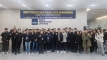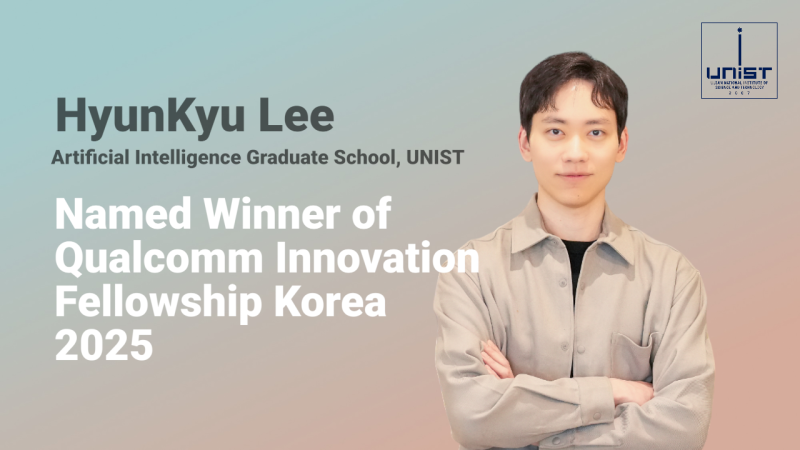
HyunKyu Lee, a combined master’s and doctoral student at the UNIST Graduate School of Artificial Intelligence (Advisor: Professor Sung Whan Yoon), has been named a winner of the Qualcomm Innovation Fellowship 2025 Korea.
The Qualcomm Innovation Fellowship (QIF) Korea is a qualified paper scholarship selection program launched in 2020 by Qualcomm Technologies, Inc. Open to master’s and doctoral students at designated universities in South Korea, the program encourages original, high-impact research through financial awards, technical mentorship, and engagement with Qualcomm researchers.
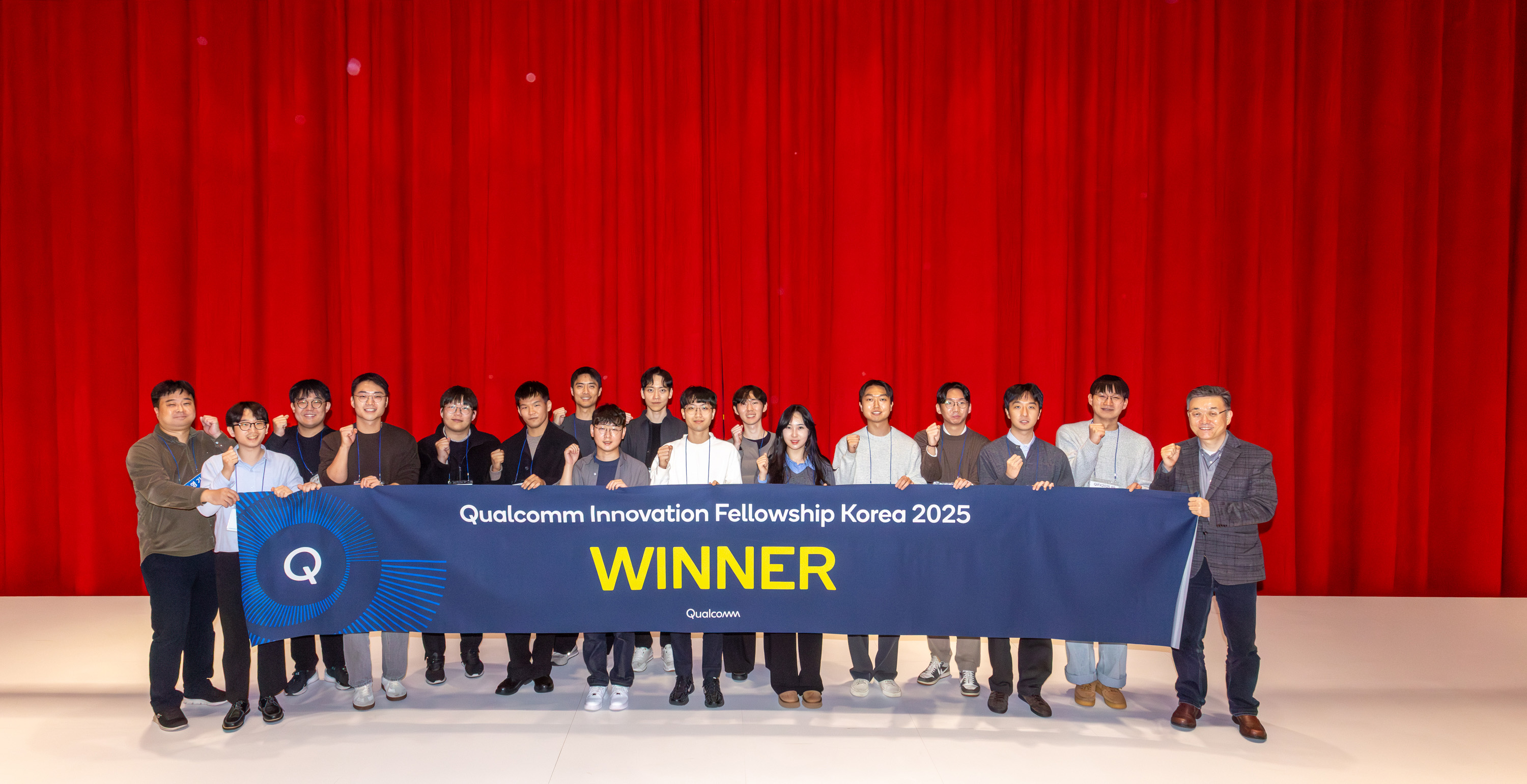
This year, 134 research papers were submitted, with only 15 selected after a competitive review process. All winning studies had already been accepted by leading international AI conferences within the past year.

HyunKyu Lee (Combined M.S.–Ph.D. Program, UNIST Graduate School of Artificial Intelligence) presents his research at the Qualcomm Innovation Fellowship 2025 Korea.
HyunKyu Lee was recognized for his work on a robust reinforcement learning (RL) method, designed to ensure reliable decision-making in unfamiliar or dynamically changing environments. His approach mitigates performance degradation by reducing sensitivity to cumulative rewards, enabling stable learning outcomes without reliance on extensive scenario augmentation. His study, title “Flat Reward in Policy Parameter Space Implies Robust Reinforcement Learning,” was selected for an oral presentation at ICLR 2025, which is top 1.8% of all submissions to the conference.
Selected for the winner of the Qualcomm Innovation Fellowship 2025 Korea, HyunKyu Lee will receive research funding, technical mentorship from Qualcomm researchers, and opportunities to engage with a global research network. Past fellows have gone on to hold faculty positions at institutions, such as Harvard University and MIT, as well as research roles at leading global technology companies, including Google DeepMind.
“I am grateful for the recognition from the Qualcomm Fellowship and ICLR,” said HyunKyu Lee. “I hope this work can contribute to real-world applications, such as robotics and autonomous driving, where strong generalization is essential.”




![[2026 UNIST Matriculation] “Design Questions the World Has Never Seen!”](https://news.unist.ac.kr/wp-content/uploads/2026/02/사진-박종래-UNIST-총장이-2026년-입학식사를-전하고-있다-1-1-190x122.jpg)