A lifetime of shared thought and dialogue between two environmental engineers has been brought together in a single volume.
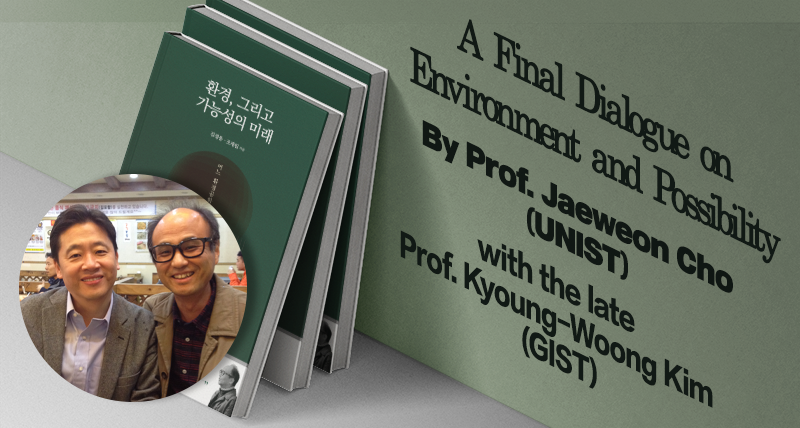
《A Final Dialogue on Environment and the Future of Possibility》 is a coauthored work by Professor Jaeweon Cho of the Department of Civil, Urban, Earth, and Environmental Engineering at UNIST and the late Professor Kyoung-Woong Kim of Gwangju Institute of Science and Technology (GIST), who passed away unexpectedly in the fall of 2025. The book presents the culmination of conversations the two environmental engineers shared over more than 30 years of research, teaching, and intellectual companionship devoted to the question of how environmental thinking can guide the future.
Work on the book was interrupted by the sudden passing of Professor Kim before the manuscript was completed. However, with the support of GIST Press—where he spent 28 years of his academic career—and the collective commitment of colleagues who wished to honor his voice, the project was brought to completion. The book brings together his final reflections on environmental challenges and the future he continued to care deeply about.
Environmental ethics is a form of scientific practice within society, aimed at proposing meaningful alternatives to the challenges we face.
 Cover of 《A Final Dialogue on Environment and the Future of Possibility》. l Image Credit: GIST Press
Rather than treating the environment as a policy issue or a field of technical intervention alone, the book presents it as a guiding principle—one that cuts across technology, society, and ethics. Through dialogue and reflection, the authors argue that environmental thinking, long regarded as peripheral, has the potential to serve as a unifying framework for understanding the defining challenges of our time.
The book addresses a wide range of contemporary issues, including the climate and energy crisis, demographic change, the ethics of artificial intelligence, and the values emerging in the era of quantum computing. These topics are examined through the lens of environmental engineering, not as isolated problems but as interconnected questions shaped by shared conditions and responsibilities.
The authors’ perspective is grounded in their lived experience as engineers who chose to step beyond disciplinary boundaries. Rather than offering prescriptive solutions, they focus on the assumptions, choices, and responsibilities that underlie technological progress. In doing so, they articulate a form of environmental philosophy shaped not by abstraction, but by long engagement with real systems and real consequences.
Professor Kim was internationally recognized for his work in soil and groundwater remediation and for his commitment to translating research into practice. Alongside Professor Cho, he led initiatives, like the Ongdalsam Project, which developed non-powered membrane water purification systems distributed to more than 20 countries, and helped establish an environmental engineering degree program at the Royal University of Phnom Penh in Cambodia.
These practical efforts resonated deeply with Professor Cho’s own approach to environmental engineering, which treats the field not merely as a technical discipline, but as a way of thinking about what society chooses to value and protect. Their shared yet differing perspectives—what Professor Cho later described as “[T]he space between agreement and difference”—form the intellectual core of the book.
Reflecting on his colleague and friend, Professor Cho writes, “The space left behind by my friend feels like a possibility—one that may yet help fill a world facing crisis. Though the seat beside me is empty, the time he left with us will remain.”
In closing, the authors acknowledge that their dialogue remains unfinished, and that its continuation now belongs to the students and researchers who will carry it forward.


![[2026 UNIST Matriculation] “Design Questions the World Has Never Seen!”](https://news.unist.ac.kr/wp-content/uploads/2026/02/사진-박종래-UNIST-총장이-2026년-입학식사를-전하고-있다-1-1-190x122.jpg)
![[2026 UNIST Commencement] “Become Way Makers Who Open Paths Where None Are Drawn!”](https://news.unist.ac.kr/wp-content/uploads/2026/02/사진-박종래-총장이-UNIST-학위수여식사를-전하고-있다-3-1-190x122.jpg)
![[2026 UNIST Commencement] Voices of Class of 2026](https://news.unist.ac.kr/wp-content/uploads/2026/02/Untitled1-190x122.jpg)