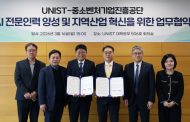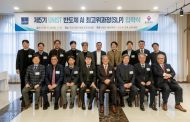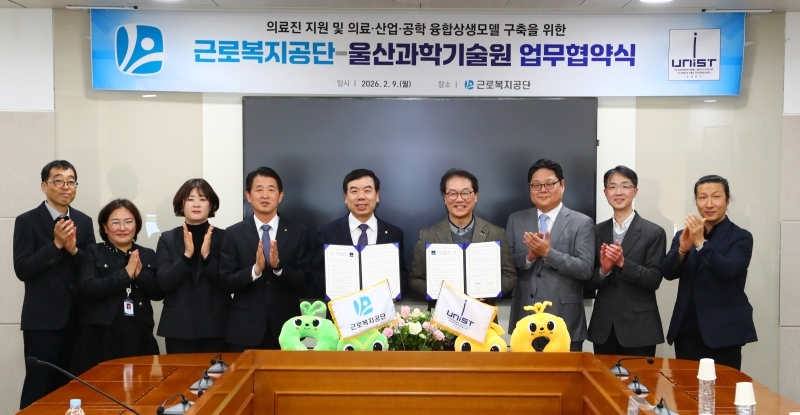
On February 9, UNIST has signed a Memorandum of Understanding (MOU) with the Korea Workers’ Compensation & Welfare Service (COMWEL) to establish a collaborative model integrating healthcare, industry, and engineering, centered on the COMWEL Ulsan Hospital (name tentative).
The agreement marks the first step toward developing a public healthcare innovation ecosystem tailored to Ulsan by combining medical services with advanced research and industrial expertise. The hospital, currently under construction and scheduled to open in the second half of 2026, will serve as the core platform for this initiative.
Under the agreement, the two institutions will cooperate in key areas, including ▲ Exchange & Support of Medical Professionals and Medical Scientists, ▲ Demonstration Research for the Improved Industrial Accident Medical Fee Systems & Application of Rehabilitation Technologies, ▲ Joint Research based on Medical AI & Biomedical Engineering, and ▲ Establishment of Co-growth Model Linking Healthcare, Industry, and engineering.
Drawing on its strengths in science and engineering, UNIST will support the hospital in developing into a distinctive public medical institution that integrates clinical services with research and innovation. The two organizations will form a working-level committee to define and implement collaborative projects in stages.
UNIST President Chong Rae Park said, “This agreement marks the starting point of cooperation where healthcare, research, and industry can grow together around the COMWEL Ulsan Hospital. We will work closely with COMWEL to ensure that UNIST’s research outcomes are applied in real clinical settings and ultimately contribute to improving citizens’ quality of life.”
COMWEL President Jongkil Park added, “The convergence of UNIST’s medical, industrial, and engineering capabilities with COMWEL Ulsan Hospital is both timely and essential. We hope this partnership will become a benchmark for public healthcare innovation not only in Ulsan, but across Korea.”
The two institutions further plan to expand demonstration research in rehabilitation medicine using advanced technologies, such as medical AI and biosensors, aiming to develop Ulsan into a leading hub for public healthcare collaboration where industrial accident treatment and cutting-edge research converge.