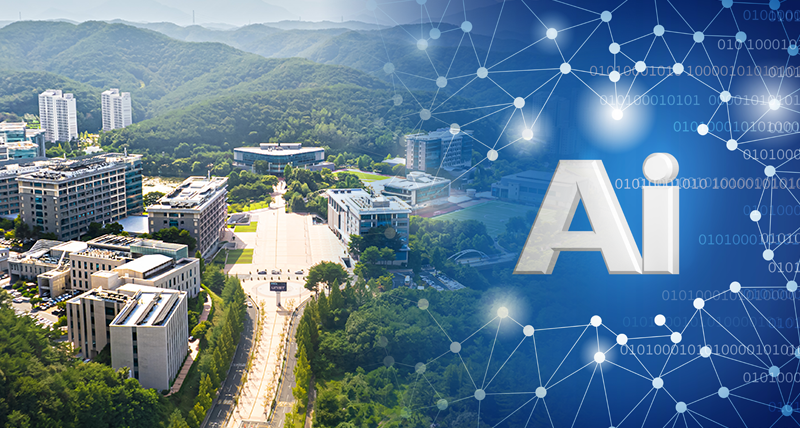
UNIST has appointed 38 new tenure-track professors through its first and second integrated recruitment rounds in 2025, marking the largest faculty expansion since the university was founded.
The recruitment attracted 1,150 applicants from Korea and abroad, underscoring strong interest from the global research community despite UNIST’s location outside the Seoul metropolitan area. The university aims to leverage this expansion to support industrial innovation in the southeastern region of Korea while contributing to the nation’s long-term competitiveness in artificial intelligence (AI).
This recruitment aligns with the government’s Busan–Ulsan–Gyeongnam (BUG) Mega-Regional Economic Alliance initiative, under which UNIST’s role as a regional research hub has continued to grow. As demand for advanced research capacity increases across the region, the need for strategic faculty reinforcement has become more pressing.
UNIST adopted a university-wide, integrated recruitment model, moving away from department-by-department hiring. By opening positions across all disciplines simultaneously, the university sought to lower academic boundaries, foster interdisciplinary collaboration, and strengthen its overall research capacity. UNIST views this approach as a key step toward reshaping its research structure to better address complex, cross-cutting challenges.
A major focus of the recruitment was early-career researchers in AI, in line with the government’s National AI Strategy aimed at positioning Korea as one of the world’s top three AI-leading nations (AI G3). UNIST plans to build a comprehensive research ecosystem spanning foundational AI technologies through applied research that can deliver impact in real-world industrial settings.
At the same time, the university recruited internationally recognized scholars, including a former associate dean from a major U.S. public university. By bringing together emerging researchers and established global leaders, UNIST expects to further strengthen its research environment and expand its capacity to nurture the next generation of academic talent.
The 38 newly appointed faculty members were selected across the following three research areas. 1) Core AI (18 positions) for advancing fundamental AI theory, technologies, and core capabilities, 2) AI+X (10 positions) for leading interdisciplinary research that integrates AI with fields such as manufacturing, energy, and biotechnology, and 3) Others (10 positions) for strengthening foundations in basic science, applied research, and interdisciplinary studies.
To further support regional industrial transformation, UNIST established the Novatus Graduate School this year and is preparing to launch a dedicated College of Artificial Intelligence. Through these initiatives, the university aims to create a virtuous cycle in which research outcomes feed into industrial application and education, reinforcing its role as a practical innovation base for the southeastern region.
UNIST President Chong Rae Park said, “This integrated recruitment reflects a strategic effort to secure outstanding talent while considering both the university’s long-term direction and the needs of the nation and the region. UNIST will continue to advance as a leading science and technology university, contributing simultaneously to regional industrial growth and Korea’s AI competitiveness.”
With this large-scale faculty expansion, UNIST expects interdisciplinary research to gain further momentum. The university plans to deepen links between research and education in advanced fields, such as manufacturing AI, while positioning itself as a key research hub supporting AI-driven industrial transformation across the pentagon region, encompassing Ulsan, Gyeongju, Pohang, Gyeongnam, and Busan.


![[2026 UNIST Commencement] UNIST Confers Degrees to 883 Graduates](https://news.unist.ac.kr/wp-content/uploads/2026/02/사진-2026학년도-UNIST-졸업생들이-학사모를-위로-던지며-졸업을-축하하고-있다-1-800x413-190x122.jpg)