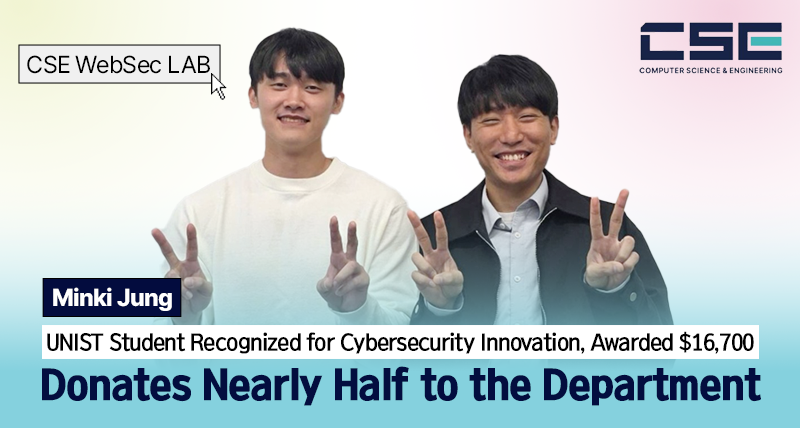
Minki Jung, a first-year master’s student in Computer Science and Engineering at UNIST, has made a remarkable impact on web security worldwide—discovering 28 vulnerabilities across major browsers, like Chrome, Firefox, Edge, Naver Whale, and Opera. His work not only identified critical security flaws, but also led to 20 patches being applied by leading companies, such as Microsoft, Naver, and Brave Software.
In recognition of his contributions, Jung received a total reward of USD 16,700 (approximately KRW 24 million) from global software firms. Demonstrating exceptional character, he donated KRW 10 million of this reward to his department to support educational and research infrastructure.
The discovered vulnerabilities could have allowed malicious actors to bypass critical web security mechanisms, such as Same Origin Policy, SameSite Cookie, Content Security Policy, and Iframe Sandbox—potentially leading to account hijacking, data leaks, keylogging, and website manipulation. His swift reporting prompted timely patches, enhancing safety for users worldwide.
Currently, his work is being prepared for submission to an international cybersecurity conference, highlighting its significance in the field.
Jung shared, “I was fortunate to receive support and encouragement from my professors and colleagues throughout the research process. I wanted my achievement to benefit others beyond myself, thus I have decided to contribute part of the reward back to my department.”
The donation will be used to strengthen research infrastructure. The department also plans to establish a Donors’ Wall to commemorate this meaningful act of generosity.
“It is truly inspiring to see a student voluntarily share his reward to advance the university community,” said a department representative. “This embodies the spirit of giving that drives UNIST’s progress.”
Professor Seongil Wi (Department of Computer Engineering, UNIST) added, “His discovery has improved browser security globally, and his donation exemplifies leadership and social responsibility. I hope many more students follow his example to make a positive difference.”




![[2026 UNIST Matriculation] “Design Questions the World Has Never Seen!”](https://news.unist.ac.kr/wp-content/uploads/2026/02/사진-박종래-UNIST-총장이-2026년-입학식사를-전하고-있다-1-1-190x122.jpg)