What began as a class project has developed into a nationally funded AI initiative, highlighting the university’s strength in linking education with industry needs.
On January 27, UNIST announced that a team project developed through coursework at the Novatus Graduate School has been selected for the government-funded ‘AI Solution Development & Demonstration Support Project.’ The selected project will receive approximately KRW 1.02 billion in research funding.
The Novatus Graduate School at UNIST offers a practice-oriented master’s program in the field of engineering for working professionals, integrating AI with technology management, business planning, and field validation. Rather than focusing on theory alone, courses are built around real challenges from participants’ workplaces and developed into team-based projects aimed at practical application.
This achievement emerged from collaborative coursework in which students applied AI technologies to operational challenges from their respective companies. Through this process, the team refined both the technical design and commercialization strategy, laying the foundation for a competitive national research proposal.
Building on this foundation, the project was expanded into a full-scale research initiative. It will focus on developing and validating an AI model based on ontology and retrieval-augmented generation (RAG) technologies, demonstrating how classroom-based ideas can evolve into practical industrial solutions.
During the project, the team worked closely with faculty members at the UNIST Novatus Graduate School to enhance technical performance and on-site applicability through applied research and field testing.
The achievement reflected the graduate school’s integrated education model, which connects problem identification, technology planning, and real-world validation within a single learning framework. It illustrates how industry experience can be systematically incorporated into academic instruction and research development.
MinGu Kim, CEO of Waff and the proposer of the project topic, credited the coursework as a turning point, noting, “The class helped me clarify challenges that I had previously approached only intuitively. Learning to structure ideas from both technical and business perspectives was especially valuable. Developing a viable project within the curriculum played a key role in this outcome.”
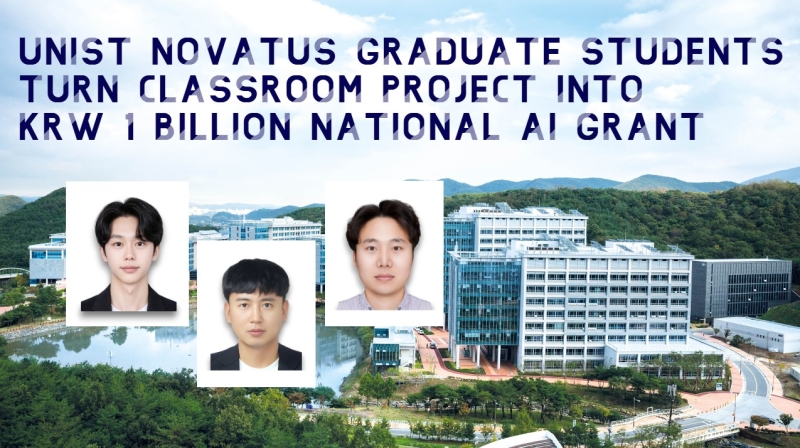
All participating students—MinGu Kim, WonSeok Oh, and BoHyun Hwang—are working professionals. Kim previously completed the Gyeongnam Navatus Academia Program, while Oh completed the UNIST AI CEO Program before enrolling in the Navatus Graduate School.
UNIST President Chong Rae Park further noted, “Despite being in its first cohort, the Navatus Graduate School has demonstrated the effectiveness of its industry-linked education through strong students and differentiated instruction. This project shows how ideas developed in the classroom can lead directly to solutions in the field.”
UNIST plans to continue strengthening its industry-based education model and supporting the development of research and business outcomes from coursework, further expanding the impact of its practice-oriented AI programs.