Students from the Graduate School of Technology and Innovation Management (MOT) at UNIST once again delivered outstanding results at the 2025 Business Model (BM) Idea Competition, held at COEX in Seoul on December 3, 2025. Their achievements reaffirmed UNIST’s growing strength in technology commercialization and project-based education.
This year, two teams competing in the private technology sector were honored with the Minister of Trade, Industry and Energy (MOTIE) Award and the President of the Korea Institute for Advancement of Technology (KIAT) Award, respectively. Both teams stood out for presenting compelling commercialization strategies grounded in NTB-registered technologies.
The annual competition brings together students from ten technology and innovation management graduate schools nationwide. Participants develop business models using technologies drawn from the National Technology Bank (NTB). Despite a highly competitive field, UNIST distinguished itself once again. Building on last year’s strong performance in both the private and public technology categories, UNIST achieved another full sweep this year—marking two consecutive years in which all participating UNIST teams received awards.
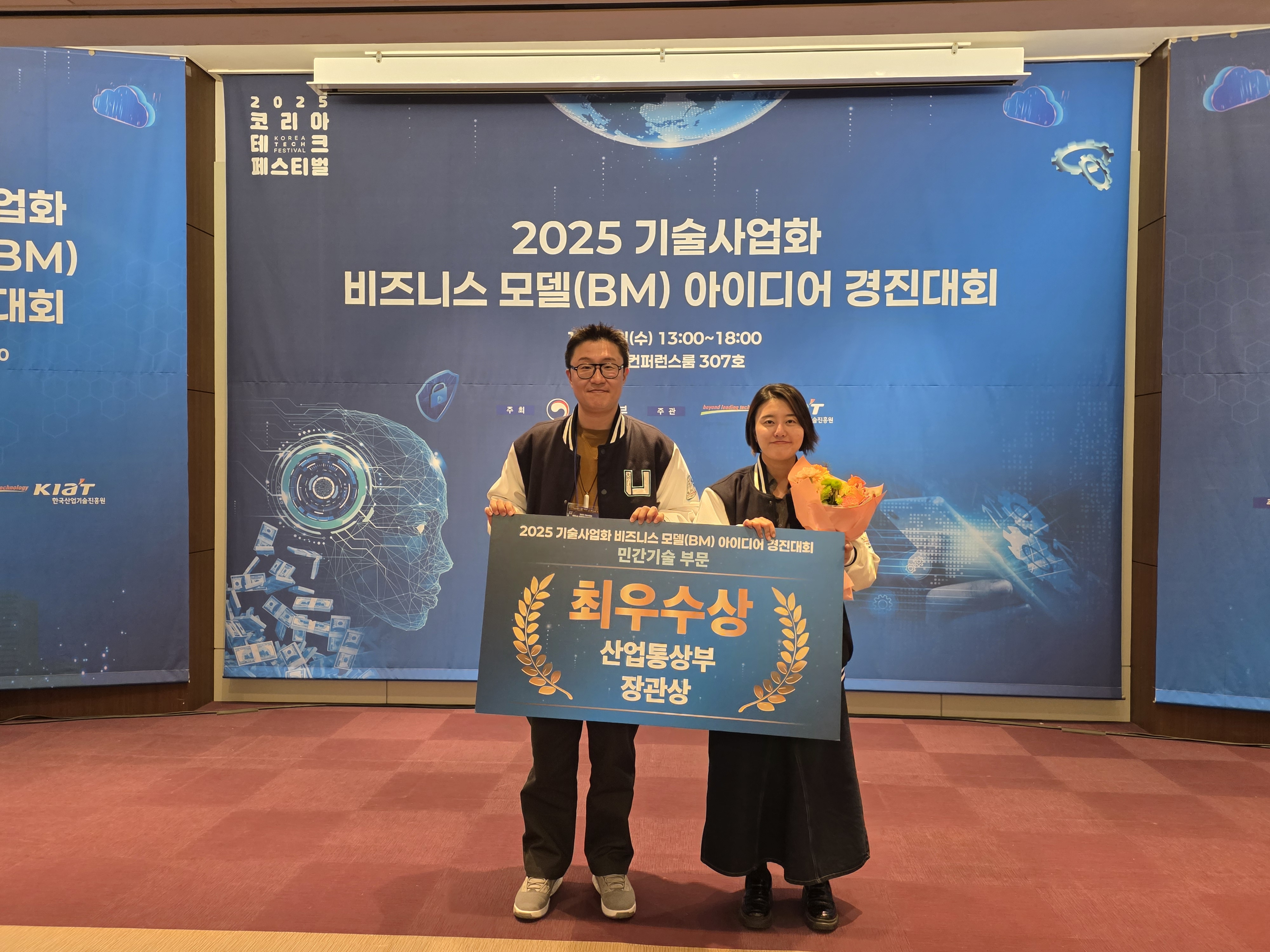
Chan Huh and HyeYeon Huh received the Minister’s Award for their business model proposal, “An AI-driven Veterinary Agent for the Prevention of Sixth Mass Extinction.” l Image Credit: UNIST MOT
The MOTIE Minister’s Award in the private technology sector was presented to Chan Huh and HyeYeon Huh, who proposed an AI-driven veterinary agent aimed at preventing future biodiversity loss. Their model utilizes AI to diagnose diseases in endangered species and automate treatment strategies. Judges recognized the proposal for its potential to enhance veterinary decision-making while contributing to wildlife conservation.
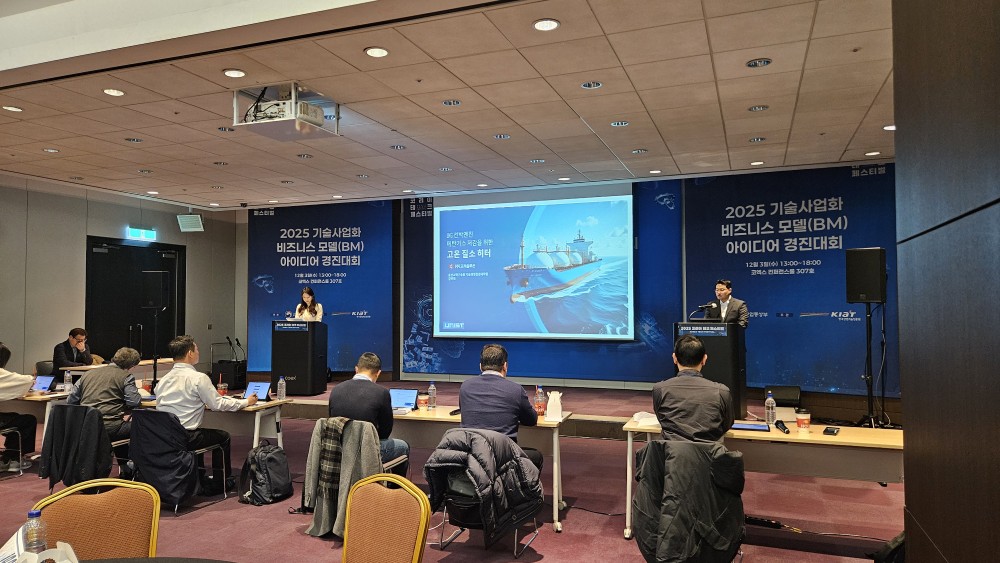
MinJae Kim (right), recipient of the KOTEC President’s Award, is presenting the “High-Temperature Nitrogen Heater for Reducing Methane Slip in LNG Ship Engines.” l Image Credit: UNIST MOT
The KIAT President’s Award went to MinJae Kim, honored for a business model leveraging a high-temperature nitrogen heater designed to reduce methane slip in LNG ship engines. With maritime decarbonization gaining global momentum, the technology was highly rated for its commercial viability and alignment with industry needs.
Award recipients credited their success to the program’s project-based curriculum and hands-on learning environment. “I entered graduate school wanting to address meaningful societal problems through technology and business,” said Chan Huh. “The project-based coursework helped turn our initial concept into a real commercialization strategy.”
MinJae Kim added, “Reinterpreting my technical experience from a market perspective was extremely valuable. Preparing for the competition helped me articulate the technology’s marketability and economic feasibility more clearly.”
Professor Young Rok Choi, Dean of the Graduate School of Technology and Innovation Management, stated, “Having both teams recognized again this year demonstrates the quality of our education and the strength of our students. We will continue to enhance a curriculum that helps transform student research into real business value and further develop our graduate school as a leading hub for technology-driven entrepreneurship and commercialization.”