unist UNIST News Center UNIST News Center
KOREAN ENGLISH
  • HOME
  • Contents
    • All News
    • News
    • People
    • Community Contribution
    • Research
    • UNIST and UIPA Partner to Support Deep-Tech Content Startups 9 hours ago
    • Highly Durable, Corrosion-Resistant PbS-QD-based Photoelectrodes for Sacrificial-Agent-Free Solar Water Splitting 13 hours ago
    • UNIST and SKKU Collaborate on Novel Bioelectronics Device Based on Hydrogel-Elastomer Conductive Nanomembranes 16 hours ago
    View all
    • UNIST and UIPA Partner to Support Deep-Tech Content Startups 9 hours ago
    • UNIST Held 2026 Freshman English Camp to Support Academic Transition 2 days ago
    • UNIST 2026 Faculty Workshop Focuses on Vision 2050 and Future Research Strategy 4 days ago
    View all
    • UNIST Undergraduates Take Top Prize at the ‘5th UNIST-KAIST-POSTECH AI & Data Science Competition’ 3 weeks ago
    • HyunKyu Lee of AIGS Wins Qualcomm Innovation Fellowship Korea 2025 3 weeks ago
    • Four UNIST Professors Elected as New Member of National Academy of Engineering of Korea 3 weeks ago
    View all
    • UNIST and PKNU Sign MOU to Promote Educational Donations and Develop Joint STEM Programs in Gyeongsang Region 5 months ago
    • UNIST Connects with Community Through Spring Concert for Children with Disabilities 10 months ago
    • Flower Beds at UNIST Given A New Lease of Life! 5 years ago
    View all
    • Highly Durable, Corrosion-Resistant PbS-QD-based Photoelectrodes for Sacrificial-Agent-Free Solar Water Splitting 13 hours ago
    • UNIST and SKKU Collaborate on Novel Bioelectronics Device Based on Hydrogel-Elastomer Conductive Nanomembranes 16 hours ago
    • UNIST and UC Berkeley Develop Microbial System to Convert CO₂ into Eco-Friendly Butanol 2 days ago
    View all
  • For Journalists
    • For Journalists
    • UNIST at a Glance
  • About News Center
    • About News Center
    • News & Communications Team
Menu
  • HOME
  • Contents
    • All News
    • News
    • People
    • Community Contribution
    • Research
    • UNIST and UIPA Partner to Support Deep-Tech Content Startups 9 hours ago
    • Highly Durable, Corrosion-Resistant PbS-QD-based Photoelectrodes for Sacrificial-Agent-Free Solar Water Splitting 13 hours ago
    • UNIST and SKKU Collaborate on Novel Bioelectronics Device Based on Hydrogel-Elastomer Conductive Nanomembranes 16 hours ago
    View all
    • UNIST and UIPA Partner to Support Deep-Tech Content Startups 9 hours ago
    • UNIST Held 2026 Freshman English Camp to Support Academic Transition 2 days ago
    • UNIST 2026 Faculty Workshop Focuses on Vision 2050 and Future Research Strategy 4 days ago
    View all
    • UNIST Undergraduates Take Top Prize at the ‘5th UNIST-KAIST-POSTECH AI & Data Science Competition’ 3 weeks ago
    • HyunKyu Lee of AIGS Wins Qualcomm Innovation Fellowship Korea 2025 3 weeks ago
    • Four UNIST Professors Elected as New Member of National Academy of Engineering of Korea 3 weeks ago
    View all
    • UNIST and PKNU Sign MOU to Promote Educational Donations and Develop Joint STEM Programs in Gyeongsang Region 5 months ago
    • UNIST Connects with Community Through Spring Concert for Children with Disabilities 10 months ago
    • Flower Beds at UNIST Given A New Lease of Life! 5 years ago
    View all
    • Highly Durable, Corrosion-Resistant PbS-QD-based Photoelectrodes for Sacrificial-Agent-Free Solar Water Splitting 13 hours ago
    • UNIST and SKKU Collaborate on Novel Bioelectronics Device Based on Hydrogel-Elastomer Conductive Nanomembranes 16 hours ago
    • UNIST and UC Berkeley Develop Microbial System to Convert CO₂ into Eco-Friendly Butanol 2 days ago
    View all
  • For Journalists
    • For Journalists
    • UNIST at a Glance
  • About News Center
    • About News Center
    • News & Communications Team
Home All News Research Understanding Why Carbon Nanotubes Grow
Understanding Why Carbon Nanotubes Grow

Understanding Why Carbon Nanotubes Grow

The work by Distinguished Professor Feng Ding at UNIST has been published in the prestigious Journal of the American Chemical Society (JACS).

Apr 11, 2022IBS Communications Team IBS
print

Carbon nanotubes (CNTs), one-dimensional hollow cylinders of carbon far smaller than the human eye can see, have attracted worldwide scientific attention and extensive research efforts since their discovery three decades ago. Their remarkable properties are highly desirable for application in next-generation electronics. However, the most fundamental question regarding CNTs, why do CNTs grow, has never been answered since its discovery in 1991.

Experimentally, it is well established that a CNT is formed on a nanometer-sized catalyst surface. Firstly, carbon atoms aggregate into a graphitic cap and adhere to the catalyst particle. Then, at a certain stage, the graphitic cap suddenly lifts off from the catalyst particle and grows into a CNT (Route II in Figure 1). Instead of lifting off to form a CNT, the continuous growth of the graphitic cap adhered to the catalyst particle until full encapsulation (Route I in Figure 1) seems more natural. So, why does a graphitic cap lift off to initiate the growth of a CNT? Without understanding this critical question, the controlled growth of CNTs cannot be realized.
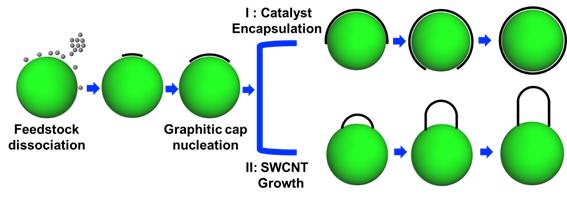
Image 1
Figure 1. Two possible routes considered for the evolution of a graphitic cap structure on the catalyst nanoparticle surface: (I) catalyst encapsulation and (II) graphitic cap lift off and CNT growth.

Recently, Distinguished Professor Feng Ding, and his colleagues from the Center for Multidimensional Carbon Materials (CMCM), within the Institute for Basic Science (IBS) at UNIST, in cooperation with researchers at the Shanxi University of Science & Technology, Jiangsu University, and the University of Newcastle, have developed and validated a theoretical model to solve this three-decade-old mystery of why CNTs grow. Using state-of-the-art density functional theory (DFT) calculations, they demonstrate that the contact angle a carbon cap makes with the catalyst surface significantly influences the stability of the carbon-catalyst interface. As the contact angle approaches 90°, it becomes increasingly energetically favorable for a graphitic cap to lift off the surface to form a CNT rather than remain adhered to it, as the interface energy difference between an adhered graphitic cap and a lifted cap increases, overcoming the adhesion between the carbon and the catalyst.

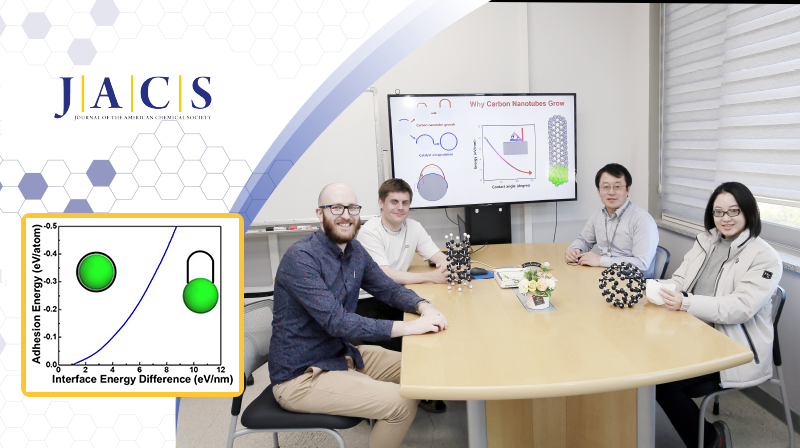
The theoretical model proposed in this work explains why CNTs grow and can predict whether growth is favorable or not for any catalyst surface based on the strength of adhesion between carbon and the catalyst and the contact angle-dependent interface energy. Figure 2 demonstrates this key relationship, providing a fundamental understanding of why CNTs grow for the first time and can be used to effectively design catalysts for selective CNT growth.
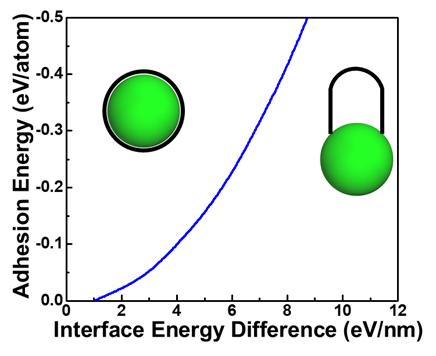
Image 3
Figure 2. The key criteria for CNT growth over catalyst encapsulation; a sufficient interface energy difference to overcome the adhesion between the carbon and the catalyst.

The authors validate their theory with extensive DFT calculations and molecular dynamics (MD) simulations, that demonstrate excellent agreement. This important work reveals a historically overlooked yet fundamental aspect of CNT growth that has puzzled the materials science community for three decades. This work has been led by Distinguished Professor Feng Ding and co-first authored by Dr. Li Ping Ding, Dr. Ben McLean, and Dr. Ziwei Xu. It has been published in the March 2022 issue of the prestigious Journal of the American Chemical Society (JACS).

Journal Reference
Li Ping Ding, Ben McLean, Ziwei Xu, et al., “Why Carbon Nanotubes Grow,” JACS, (2022).

Tags: Carbon nanotubesCatalystsCNTEncapsulationEnergyENGIBS CMCMInterfacesJACSJournal of the American Chemical Society
Share 0
Tweet 0
Share 0
Share 0
Share 0
  • Previous

    UNIST Professor Selected for 2022 Samsung Future Tech Fostering Project!

  • Next

    UNIST Signs Cooperation MoU with Seoul National University Bundang Hospital

author photo

Writer|IBS Communications Team |IBS

042-878-8114
webmaster@ibs.re.kr

Related Articles

  • Highly Durable, Corrosion-Resistant PbS-QD-based Photoelectrodes for Sacrificial-Agent-Free Solar Water Splitting

    Highly Durable, Corrosion-Resistant PbS-QD-based Photoelectrodes for Sacrificial-Agent-Free Solar Water Splitting

    Feb 06, 2026
  • UNIST and SKKU Collaborate on Novel Bioelectronics Device Based on Hydrogel-Elastomer Conductive Nanomembranes

    UNIST and SKKU Collaborate on Novel Bioelectronics Device Based on Hydrogel-Elastomer Conductive Nanomembranes

    Feb 06, 2026
  • UNIST and UC Berkeley Develop Microbial System to Convert CO₂ into Eco-Friendly Butanol

    UNIST and UC Berkeley Develop Microbial System to Convert CO₂ into Eco-Friendly Butanol

    Feb 05, 2026
  • New Adaptive PID Control Allows Industrial Robots to Handle Sudden Heavy Loads without Vibrations

    New Adaptive PID Control Allows Industrial Robots to Handle Sudden Heavy Loads without Vibrations

    Feb 04, 2026

Popular

  • New Study Unveils Ultra-High Sensitivity Broadband Flexible Photodetectors

    New Study Unveils Ultra-High Sensitivity Broad..

    Jan 30, 2026
  • UNIST and HHI-TMC Join Hands to Advance SMR Technology and Cultivate Specialized Talents

    UNIST and HHI-TMC Join Hands to Advance SMR Te..

    Jan 29, 2026
  • New Study Unveils High-Voltage Power Generator Inspired by Electric Rays

    New Study Unveils High-Voltage Power Generator..

    Jan 29, 2026

UNIST E-Newsletters

Sign up today to receive a copy of the UNIST e-newsletter

<Personal Information Processing Consent Form>
UNIST wishes to obtain consent from Newsletter subscribers to the collection and processing of their personal information. Please read this document in its entirety before giving consent (select each blank as appropriate).

1. Items to be collected : e-mail address
2. Purposes of collection and use : to provide Newsletter service
3. Period of holding and use : until your cancelation
4. You have the right to refuse consent. However, you may not be provided with the aforementioned services due to rejection.
I give my consent for all personal information to be processed for the purposes described in this document and understand that I can withdraw my consent at any time.
  • UNIST Daily
  • UNIST Newsletter
  • For Journalists
logo
50 UNIST-gil, Ulsan 44919, Republic of Korea
Phone : +82 52 217 0114 /Admissions : +82 52 217 1120
  • Contents
    • News
    • People
    • Research
    • Photo & Video
  • For Journalists
    • UNIST at a Glance
  • About News Center
    • About News Center
    • UNIST Newsletter
    • Send Your Story Ideas
    • News & Communications Team