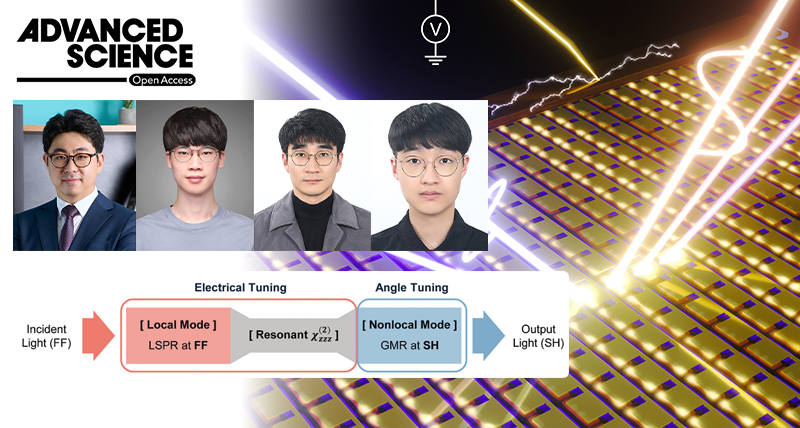
A research team, affiliated with UNIST has reported an ultra-compact chip, roughly the size of a grain of sand, that can independently adjust the wavelength and brightness of light without these functions interfering with each other. This breakthrough could enable real-time control of quantum light sources and lead to the development of extremely small, high-performance optical devices.
Led by Professor Jongwon Lee from the Department of Electrical Engineering at UNIST, the team announced the successful development of a new metasurface, capable of separately controlling two key aspects of a nonlinear optical process called second harmonic generation (SHG). This marks a significant milestone in the field.
Metasurfaces are ultra-thin surfaces made up of tiny, nanometer-scale structures. These structures manipulate light in ways that natural materials cannot, allowing for highly customized control of optical properties. Because they are so small and lightweight, metasurfaces can replace bulky optical components, paving the way for more compact and versatile photonic devices.
The reported metasurface specifically controls SHG, a process where incoming light at a certain wavelength is converted into light with twice the energy—meaning a shorter wavelength. For example, infrared light can be converted into visible light. This capability is useful for sensitive biosensors that detect tiny biological molecules, as well as for secure quantum communication systems that require untraceable data transfer.
Until now, controlling both the wavelength and the intensity of SHG simultaneously has been very difficult. Improving the efficiency of the process often meant sacrificing the ability to tune the wavelength, and vice versa—creating a fundamental trade-off that limited practical applications.
The team solved this by designing a metasurface that separates the light’s journey into two distinct steps: one inside the chip, where the light is generated, and one outside, where the light is emitted. This local-to-nonlocal approach allows the two parameters—wavelength and intensity—to be tuned independently.
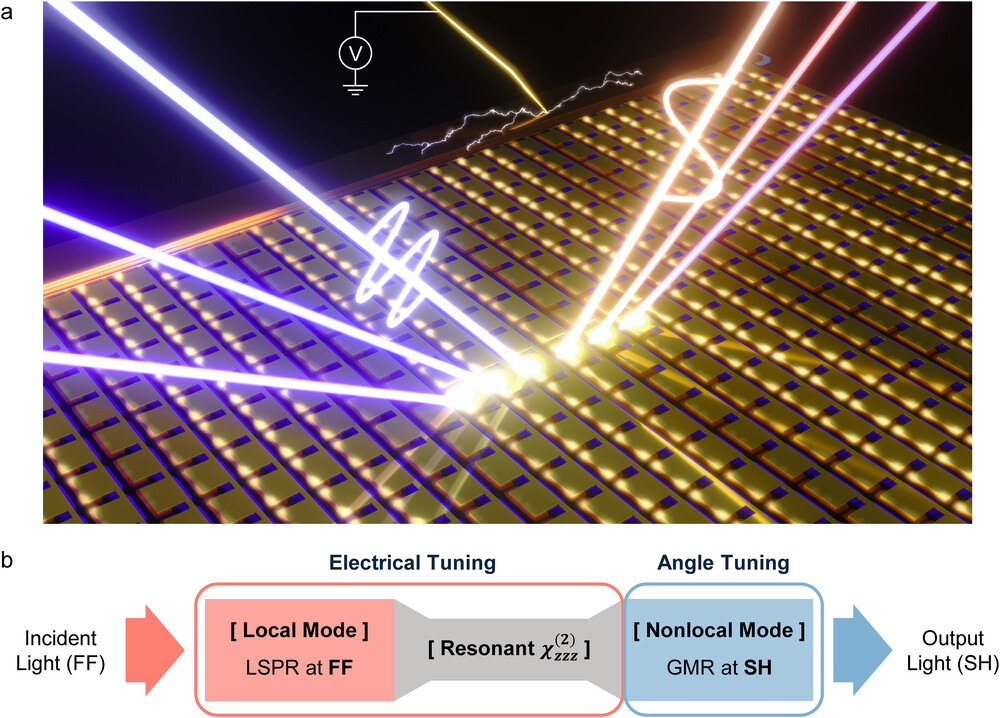
Figure 1. Concept of the local-to-nonlocal SHG process. a) Schematic illustration of dual-tunability from a nonlinear intersubband polaritonic metasurface for SHG. b) Diagram of the local-to-nonlocal SHG process. The incident FF light is absorbed via a localized mode, while the generated SH light is out-coupled through a nonlocal mode. In the designed metasurface, the local and nonlocal modes are independently controlled by electrical bias and incident angle, respectively.
Specifically, by adjusting the voltage applied to the chip, they can change the brightness without affecting the wavelength. Conversely, tilting the angle at which light enters the device shifts the wavelength while keeping the brightness constant. The experiments confirmed that these two controls work separately and effectively.
Professor Lee noted, “Previous methods relied only on either trapping or guiding light, but our design combines both strategies. This gives us much more flexibility and solves the long-standing dilemma of balancing efficiency with tunability.”
He further added, “This technology could play a key role in next-generation quantum devices, allowing precise, real-time control of quantum information and the spectral properties of entangled photon pairs, which are essential for secure quantum communication.”
The findings of this research have been published in Advanced Science on November 29, 2025. The study was supported by the Institute for Information & Communications Technology Planning & Evaluation (IITP) and the National Research Foundation of Korea (NRF).
Journal Reference
Jaesung Kim, Hyeongju Chung, Seongjin Lee, et al., “Local-to-Nonlocal Second-Harmonic Generation from Electrically Tunable Intersubband Polaritonic Metasurfaces,” Adv., Sci., (2025).