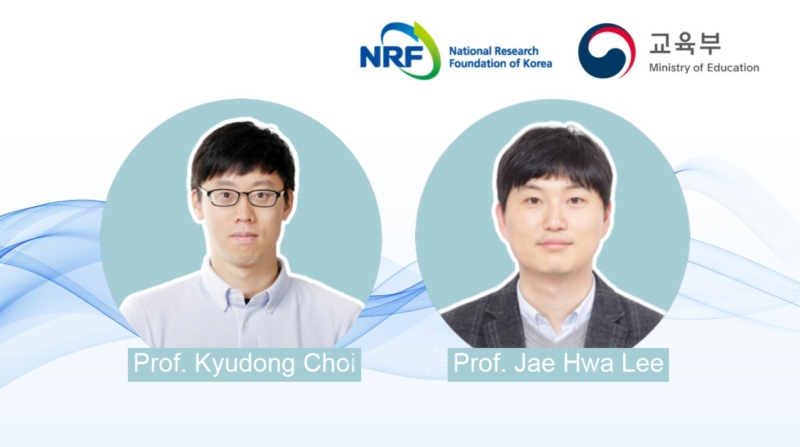
Two UNIST faculty members—Professor Kyudong Choi of the Department of Mathematical Sciences and Professor Jae Hwa Lee of the Department of Mechanical Engineering—have been selected for the Top 50 Outstanding Academic Research Achievements by the Ministry of Education, an annual recognition honoring significant outcomes from government-supported research.
This year, 245 research results from projects funded in 2024 were submitted through nominations and open calls. Following evaluation for originality, academic quality, and scholarly contribution, 50 works were selected. Awardees were given a Minister of Education Commendation at the ceremony held on December 9 at the Grand InterContinental Hotel in Seoul.
Professor Kyudong Choi was recognized for resolving a long-standing theoretical problem in rotating fluid motion that had remained open for more than 130 years. His research addresses the mathematical stability of vortex structures that arise in rapidly rotating flows, such as those observed in typhoons.
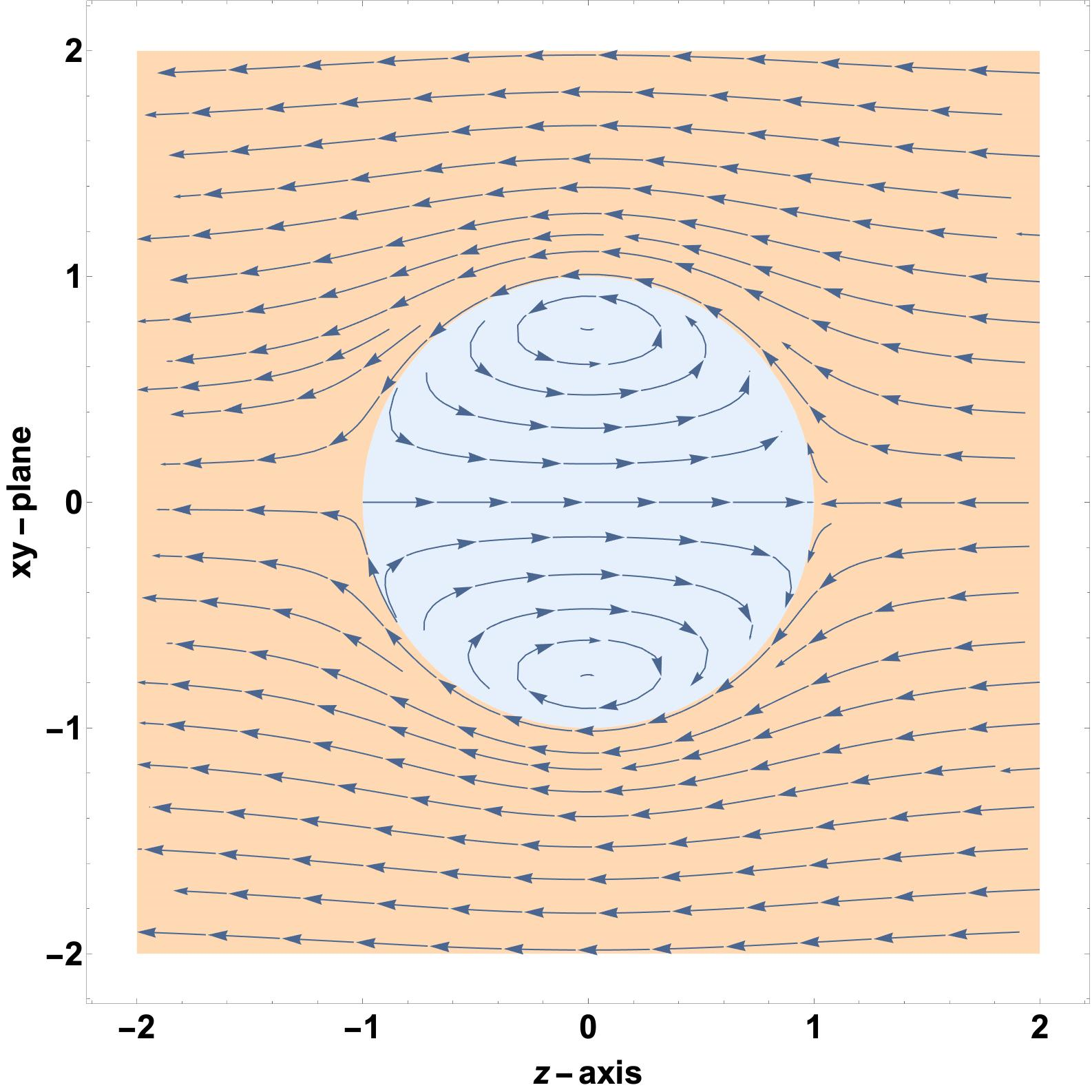
Figure 1. The streamline of Hill’s spherical vortex in the moving frame.
Such flows are often modeled using Hill’s spherical vortex, a classical solution in fluid dynamics. However, the model’s discontinuous boundary has long made it difficult to determine whether these vortices can exist stably. Professor Choi and his team proposed a new analytical framework that applies boundary conditions closer to those found in natural systems, allowing previously intractable discontinuities to be handled in a mathematically rigorous way.
Using this approach, the team proved for the first time that spherical vortices can remain stable while maximizing kinetic energy under specific conditions. The study provides a theoretical foundation for the stability of three-dimensional localized vortices and represents a meaningful advance in the field of fluid dynamics.
The research was published in Communications on Pure and Applied Mathematics (CPAM), one of the leading journals in pure and applied mathematics, and also received the Korean Mathematical Society (KMS) Paper Award.
“This work reflects the growing international presence of Korean research in fundamental mathematics,” Professor Choi said. “I hope it helps broaden the theoretical basis for studies in fluid stability and climate-related phenomena.”
Professor Jae Hwa Lee was selected for his research on bio-inspired underwater propulsion, based on the swimming mechanics of manta rays. While many existing designs rely on actively controlling an entire flexible structure, Professor Lee’s work focuses on passive flexibility, in which only the leading edge is controlled and the rest of the motion emerges through interaction with surrounding fluid.
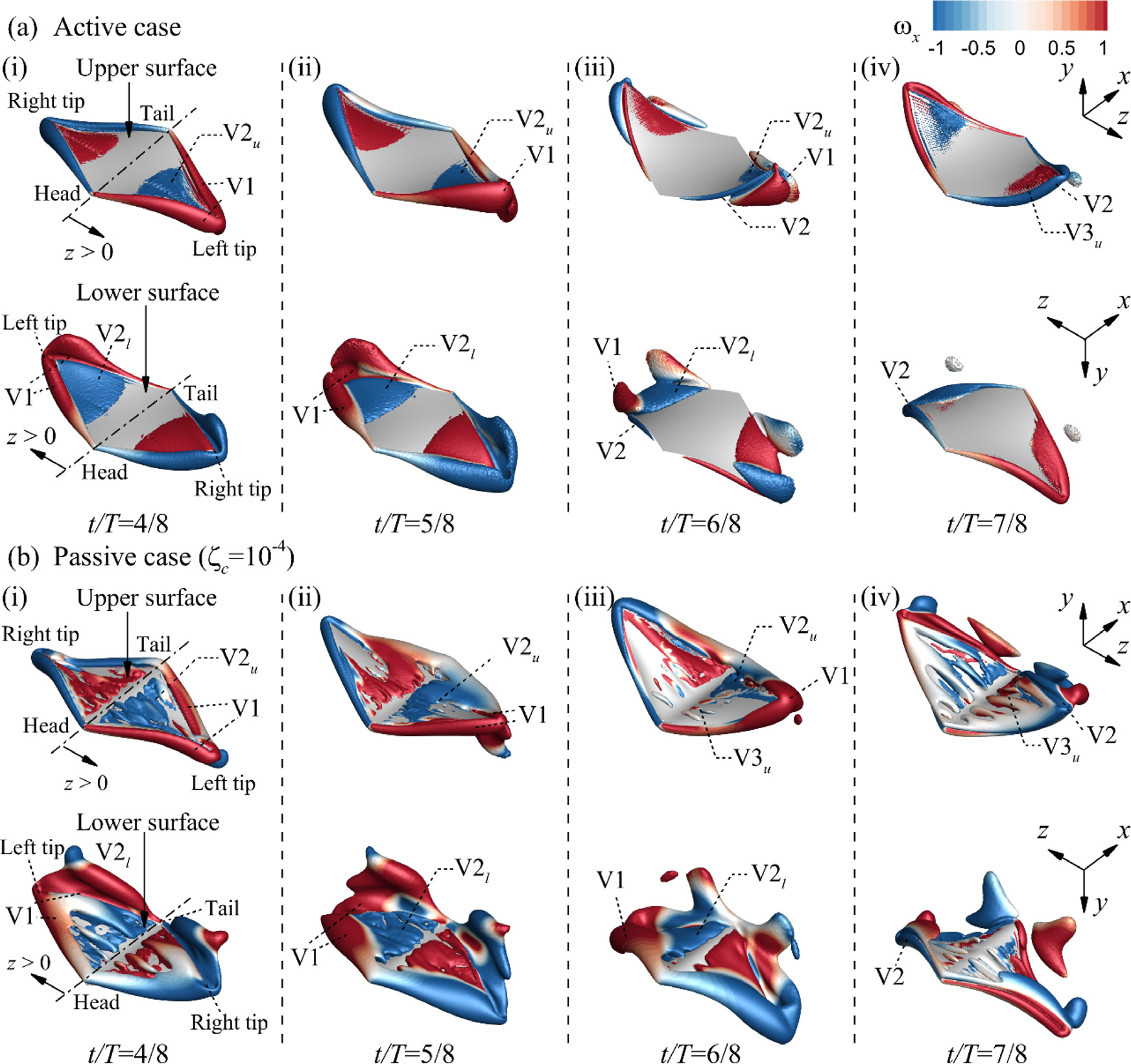
Figure 2. 3D vortical structures visualized by the isosurface of Q-criterion (Q = 1.5) around the ray when (i) t/T = 4/8, (ii) t/T = 5/8, (iii) t/T = 6/8, and (iv) t/T = 7/8: (a) active case and (b) passive case with ζc = 10−4. The isosurface of Q = 1.5 is colored by the horizontal component of vorticity (ωx).
The team found that this mechanism generates strong vortex structures along the body and maintains positive pressure even at higher speeds, enabling greater thrust with lower energy consumption. The study has been noted for proposing an alternative, efficiency-focused approach to underwater propulsion. Their findings were published in Physics of Fluids, an international journal in fluid mechanics.
“Collaboration across disciplines was essential to this research,” Professor Lee said. “We plan to combine these findings with AI-based control techniques and extend the work to autonomous underwater vehicles and bio-inspired robotic systems.”
UNIST President Chong Rae Park congratulated the researchers, noting that their achievements reflect UNIST’s emphasis on connecting foundational theory with practical innovation.



![[2026 UNIST Matriculation] “Design Questions the World Has Never Seen!”](https://news.unist.ac.kr/wp-content/uploads/2026/02/사진-박종래-UNIST-총장이-2026년-입학식사를-전하고-있다-1-1-190x122.jpg)