A joint research team from UNIST and the University of California, Berkeley has unveiled a novel microbial process to convert carbon dioxide (CO₂) into butanol, an environmentally friendly fuel. This innovative approach utilizes a continuous bioprocess involving two specialized microorganisms working in tandem.
With increasing urgency to address climate change, converting greenhouse gases into valuable resources has become a key focus of sustainable innovation. Microbial conversion offers a sustainable solution, as microbes naturally consume CO₂, producing useful compounds with minimal energy and without relying on expensive catalysts.
The system links two microorganisms in a streamlined production line. The first stage utilizes S. ovata to produce acetate (CH₃COOH) from CO2 and H2 autotrophically. This simple molecule then serves as the sole carbon source for metabolically engineered E. coli, which synthesizes butanol (C₄H₉OH)—a versatile liquid fuel. This division of labor addresses the limitations of single-microbe systems in converting gaseous CO₂ directly into complex fuels.
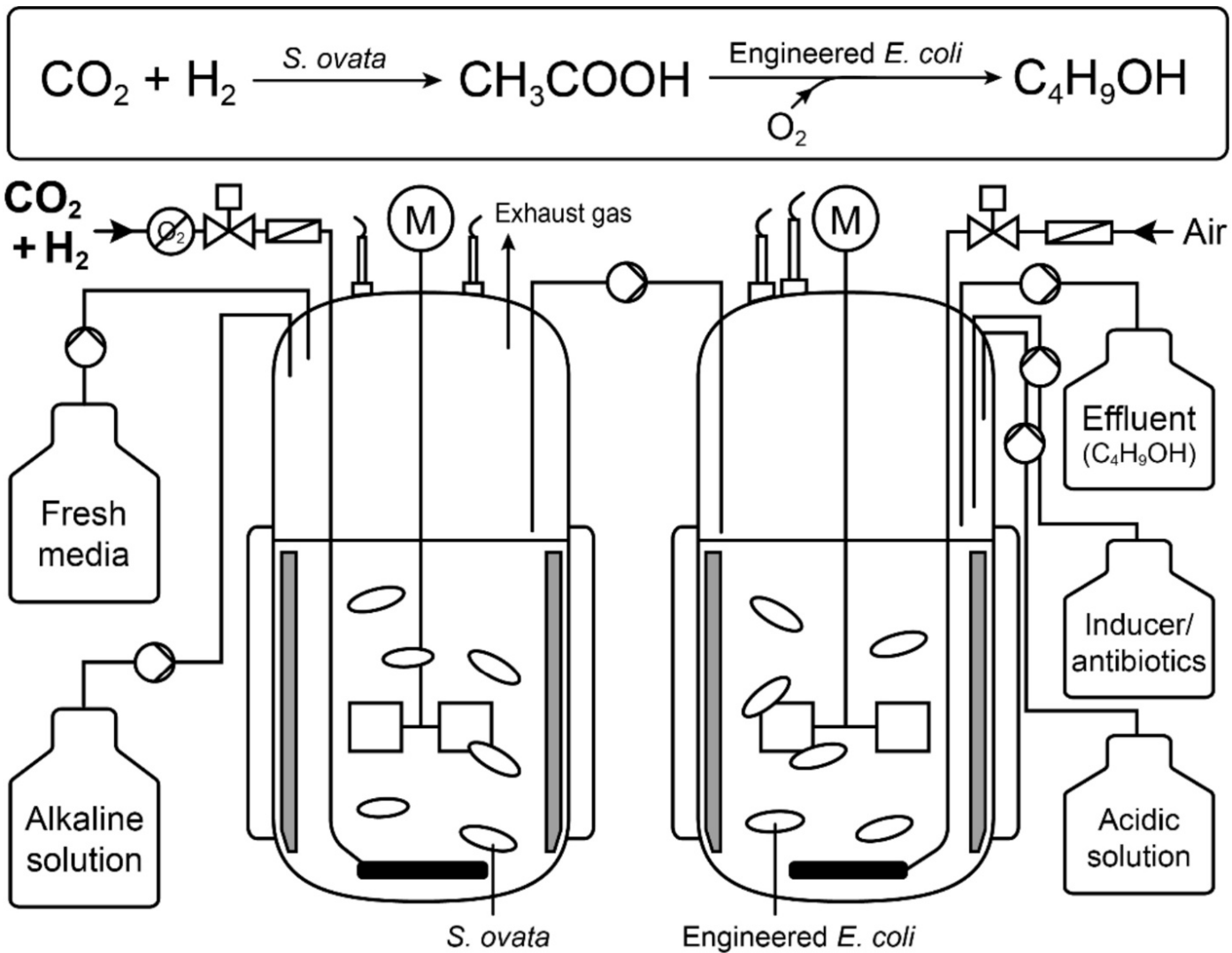 Figure 1. Schematic of microbial production of butanol with two chemostats.
The team further improved E. coli’s butanol production efficiency by approximately 3.8 times through targeted genetic modifications. By optimizing acetate uptake and redirecting metabolic energy toward butanol synthesis, they enhanced overall productivity.
The continuous system operated stably for over 90 hours, producing butanol solely from CO₂ and hydrogen, without the need for external organic carbon sources. Hydrogen fuels the initial conversion of CO₂ into acetate, which is then transformed into butanol by the engineered bacteria.
Professor Jinhyun Kim from the Department of Materials Science and Engineering at UNIST stated, “Successfully integrating two continuously operated bioreactors to sustain steady input and output demonstrates a significant advance. With further optimization, this platform has the potential to serve as a sustainable alternative to fossil fuels and help accelerate a transition to a carbon-neutral future.”
This work was led by Professors Douglas S. Clark and Peidong Yang of UC Berkeley’s Department of Chemical and Biomolecular Engineering and Department of Chemistry, respectively, with Professor Jinhyun Kim of UNIST serving as the first author. The research was published in the online version of Bioresource Technology on December 24, 2025.
Journal Reference
Hye-Jin Jo, Hee-Jeong Cha, Jinhyun Kim, et al., “Two-stage process and strain engineering for continuous bioconversion of CO2 to butanol,” Bioresour. Technol., (2025).