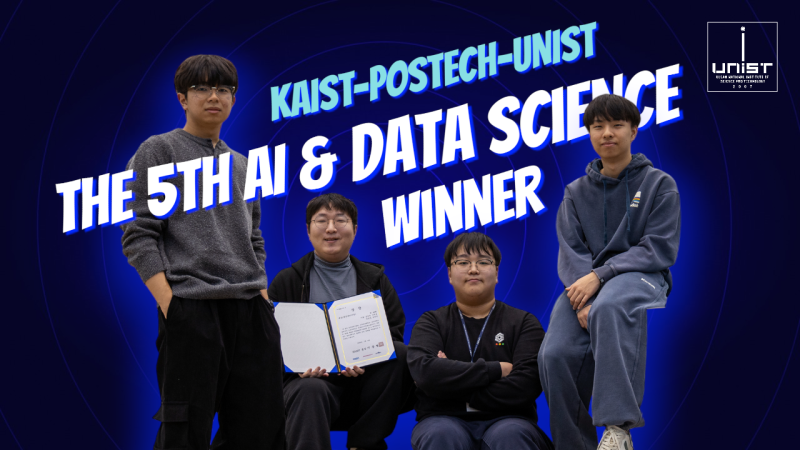
A team of undergraduate students from UNIST has won the top prize at the 5th KAIST-POSTECH-UNIST AI & Data Science Competition, outperforming teams from KAIST and POSTECH.
The UNIST team, RPM, received the Grand Prize (Hankook Tire Award) at the competition, which brings together undergraduate students from universities nationwide to tackle data-driven challenges grounded in real industrial problems.
Team RPM was led by Seonuk Kim from the Department of Industrial Engineering, with MinJun Kim from the School of New UNISTars, Seongho An and MinGuk Jeon from the Department of Computer Science and Engineering. Since the competition’s inception, the grand prize had consistently been awarded to KAIST teams, making this the first time UNIST has claimed the top honor.
Co-hosted by UNIST, KAIST, and POSTECH and sponsored by Hankook Tire & Technology, the competition drew 83 teams and 238 participants. Entries were evaluated on the logical rigor of their approaches and their applicability to industrial settings.
The team developed a deep learning–based framework using transformer and LSTM models to predict tire defect rates and support production decision-making. By integrating automated model selection (AutoML) and iterative learning agents, they directly linked predictive performance to operational decisions. Judges also noted the team’s systematic incorporation of production-scale risk, highlighting the solution’s practicality for real-world deployment.
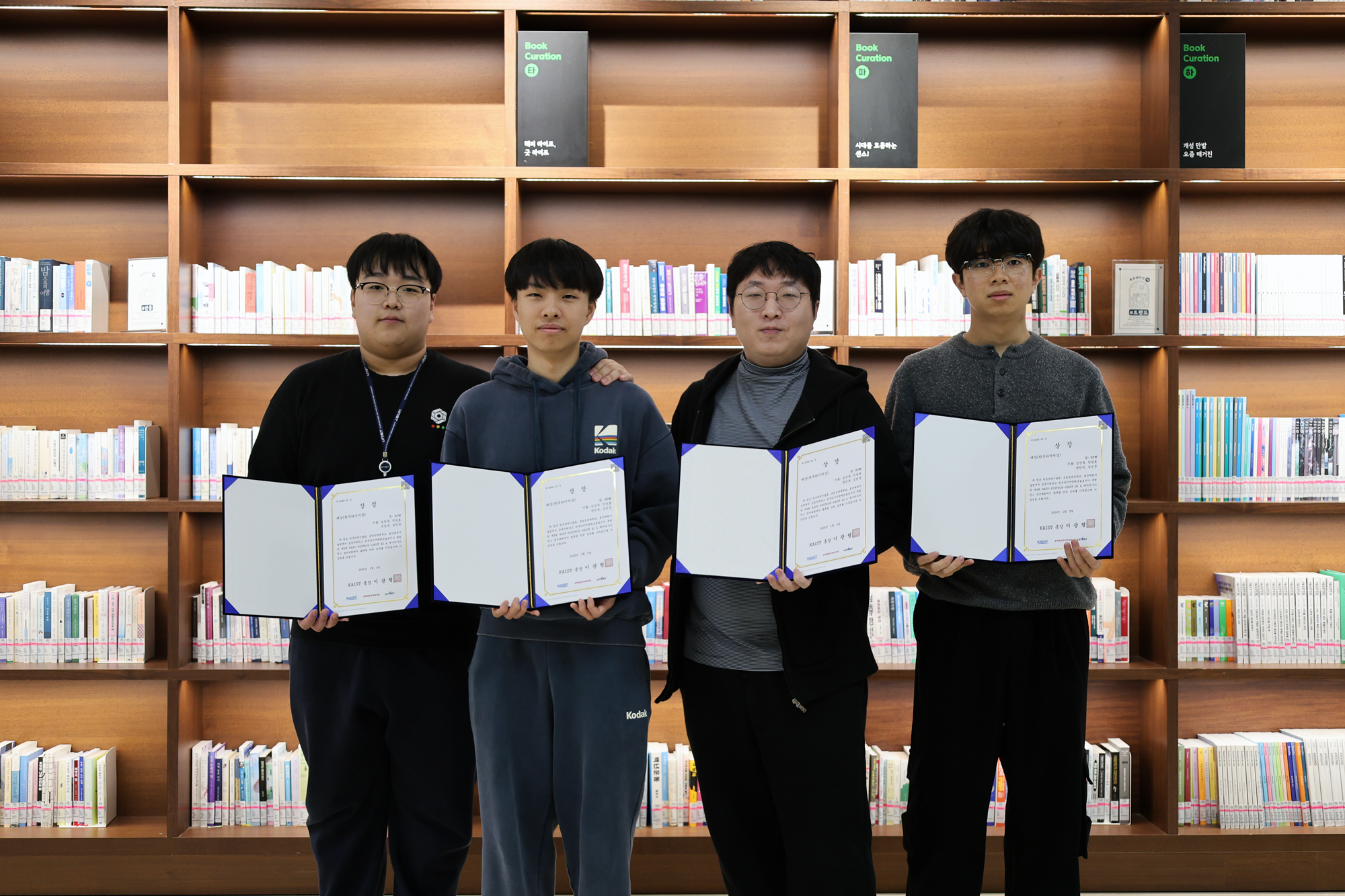
Team RPM, consisting of Seonuk Kim (Department of Industrial Engineering), with MinJun Kim (School of New UNISTars), Seongho An, and MinGuk Jeon (Department of Computer Science and Engineering).
The students attributed their success to interdisciplinary training and hands-on research experience. “Applying what we learned as undergraduate researchers to a real industrial challenge made the experience especially meaningful,” said Seonuk Kim and MinGuk Jeon. “We are grateful to our faculty advisors for their constant support.”
Seongho An and MinJun Kim added that prior experience working with limited datasets—particularly in medical AI projects—proved valuable. “It helped us adapt our models under constraints,” they said. “The competition also showed how students from different fields can collaborate effectively.”
Faculty advisors, Professors Chiehyeon Lim and Yongjae Lee of the Department of Industrial Engineering emphasized the educational significance of the achievement. Professor Lim noted, “The students’ ability to define the problem independently and develop an end-to-end solution was the most impressive part.” Professor Lee added, “This achievement reflects UNIST’s approach to connecting AI and data science with real industrial challenges from the undergraduate level.”